Tuesday, September 01, 2009
The '70s - The Golden Age Of TV? I Think Not...
It began in 1969.
"Ah," say '70s fans," but it was at its height in the early '70s!"
Oh, I see.
Not The Nine O'Clock News was "at its height", and indeed had the line-up we all remember, in the early 1980s.
But it appears on the BBC "I Love The 1970s" site on the 1979 page.
"Ah," say '70s fans, "But it BEGAN in 1979."
Um... er... does not compute.
Meanwhile, let's not forget the 1970s had its fair share of dross (Take The Wife or Rings On Their Fingers, anybody?).
And for every The Sweeney there was a few dozen flops.
And didn't the 1960s and 1980s also have lashings of memorable and innovative TV shows?
I think they did.
Do we reject the 1960s because the shows were largely in black and white?
Do we reject the 1980s because it was the era of Thatcher and Reagan?
The "Golden Age of Coronation Street" is also apparently the 1970s. But the show slipped catastrophically in the ratings in the early 1970s! And I find many of those episodes unwatchable. Things perked up brilliantly when Bill Podmore became producer in 1976, but that hardly qualifies the WHOLE of the 1970s as being the "Golden Age" of Corrie, does it?
The '70s had some great TV.
It also had loads of trash.
Rather like the 1960s and 1980s.
So, people, please try and CONVINCE me otherwise, please! Try to make me see what you see.
And comments such as:
"70s woz great, wot are you talking about?" will not be published.
Saturday, August 22, 2009
Views Of The '70s Part 2 - Klackers, Racism, The Cambridge Rapist, Frisbees, Digital Watches And Maxi Skirts...
No videos of TV series, but books based on them instead - Upstairs Downstairs, the '70s answer to the '60s Forsyte Saga, was hugely popular both on TV and in book form.In the second part of our "Views Of The '70s" series, Christine, who is now fifty-one, looks at life in the decade for a young working class woman...
It's odd what's written about the '70s and I know a lot of it is not true. Firstly, the '70s were not a time of dazzling new technology, that was the '80s - and a lot of it was clunky and unaffordable even in the '80s!
The '70s, for me, was the last non-technological decade. We had the TV, of course, and although colour had come out in 1967, my family had black and white in the '70s. The licence was a lot cheaper, and we couldn't afford to buy or rent colour.
New technology in the 1970s was things like calculators and digital watches. I never had a calculator, I didn't know anybody who did, but digital watches from around the mid-1970s to the mid-1980s were objects of desire. There were several boys I knew flashing them around - it was hinted some of them had "fallen off the back of a lorry", and they weren't very reliable. I remember one lad showing me his digital watch, proud as punch, "Look at this!" and I looked, and the face was blank!
"Battery must've gone!" he said.
"But you've only just got it!" I laughed.
Nobody I knew could afford a video recorder - and we never dreamt of having one. They came home to roost in the 1980s.
TV games systems, computers, all that kind of thing did not get going until the 1980s.
But that's a reason why I have fond memories of the '70s - because we led much simpler lives. Mind you, I have fond memories of the '80s too, because technology from that decade now seems so funny.
I left school in 1974, and the sort of things I'd amused myself with as a kid were things like colouring books and Spirograph - a '60s game that was huge in the '70s. I loved it dearly.
And there were klackers - a huge craze in the early '70s. I don't know why now. As I say, simpler times!
Kids were not really innocent in the 1970s. I remember even little girls, under elevens, singing one of the favourite rhymes of the time: "Ooh, Ah, I Lost My Bra, I Left My Knickers In My Boyfriend's car!"
Innocent?
I didn't like pop groups like Led Zeppelin - they seemed a bit of a '60s hangover, and nobody round my way wanted to be thought a hippie. That was '60s - dead and gone, as far as we were concerned. We did wear flares, the bigger the better, but not because of their '60s hippie roots. They were just a great fashion. There was a lot of snobbery surrounding groups like Led Zeppelin. I knew a girl who was into them and she was really up herself - and lived in a nice, semi detached house in a nice avenue!
Listening to the charts on Radio 1 and watching Top Of The Pops were our weekly doses of the pop scene. And you could get pop magazines, Donny Osmond posters, etc. There was one magazine called 45 and it had all the words of the latest songs in it. I used to get that, because it was sometimes hard to hear what people were singing on our decrepit old record player and radio!
My favourite pop star was David Essex. He seemed gentle and had the most wonderful eyes. I also liked Gilbert O'Sullivan. I liked my pop to be fun and/or gentle. Noddy Holder had a mouth like a barn door, and seemed like an overgrown schoolboy. Little Willy won't go home! How I wished Noddy would bog off!
I think people were getting very cynical back then, they were hard times, and people talked about the '70s being a "hangover decade" - the '70s were paying for the '60s party. But, cynical or not, in the '70s, and in the '80s too, we'd still cry over schmaltzy rubbish. I wept buckets over Terry Jacks's Seasons In The Sun...
"It's hard to die when all the birds are singing in the sky..." Still makes me tearful!
There was well over a million unemployed, and when I left school I worried about getting work. My step-mother thought I should join up! She took me to the Army Centre in Cambridge - almost frog-marched me there! They had a chat, my step-mum was pretty determined, but I didn't want to go in and it didn't work out.
I had three crumby jobs - the first was making and packing hand-made jewelry - £10 a week - for a 40 hour week! You could not live on £10 a week even then, no way! I got laid off from there, and went to Cambridge to find work. It wasn't easy, even there. I went to the Citizens Advice Bureau, who gave me addresses to help find jobs and accommodation.
I finally got a job with Cambridge University in the Metallurgy Department. The pay wasn't great, but it was liveable. The Cambridge Rapist was on the loose... Terrifying! This man wore a black balaclava-type mask, with "RAPIST" written on it when he was on the prowl... and he was absolutely for real.
I got a ground floor bedsit with mice in it and an old sash window without a lock! I was so frightened because of the rapist. I imagined waking up to find him in my room. I screwed the window frames together, and got into trouble with the landlord about it for damaging his property - he didn't seem to give a damn about my safety!
I loved the arrival of Disco music, but didn't like Punk. A friend of mine said she thought Johnny Rotten was sweet. That was the '70s!
Toys for kids were still things like colouring books and Plasticine, and, around 1976, the Frisbee came over from America and was a huge craze.
The '70s were not a decade to be timid in, and I think I was timid! I wore glasses and was picked on at school, and I remember in Cambridge one day during the heatwave of 1976, I was in the town centre when a gang of youths started following me, shouting terrible obscenities, and jostling me. It was a busy area of the town, but nobody came to my aid. In the end, I ran into the police station. The boys disappeared faster than light!
I got married in 1977 and, although it didn't last (I was divorced in the late 1980s), I was happy for some years.
Fashion in the '70s was funny. We were very influenced by the 1960s and it was a bit garish and yucky early on, but there were some nice things. I remember smock tops - which were lovely retro garments, and long dresses with puffed sleeves came back. Denim jean skirts were also popular. The mini and the maxi were both introduced in the '60s, of course, but after a while the maxi saw off the mini in the 1970s and maxis with black tights were very popular.
We didn't go abroad on holidays. I've read that foreign holidays became increasingly popular from the '60s onwards, but we couldn't afford that, and neither could anybody else we socialised with. And yet we had lovely holidays in England - and I still favour the South Downs or Yorkshire over any foreign destination I've visited.
With three TV channels, the box was far more of a shared experience and in the '60s, '70s and '80s, there were many fads and catchphrases. There was one ad, I think it was for Playtex, and it may have been late '60s, but in it a very posh woman said: "My girdle's killing me!" and we all went around saying it for ages. And the ad for Cadbury's fruit and nut chocolate, in the early '70s, "Everyone's a fruit and nut case", ended with a secretary saying: "Full stop, Sir?" and we all went round saying that, too...
Then there was Anchor Butter... the ad went: "If you want a better butter, there's no other name you'll utter, because Britain's better butter bears the Anchor sign!" Great. But we all ate margarine, because it was so much cheaper.
I remember the ad for McVities digestive biscuits - with a Welsh man being offered a cup of tea and saying: "It's too wet!" A drink was, apparently, too wet without a McVities digestive!
And the Muppet Show with the song "Ma Na A Na". Everybody was saying it. I remember saying to my insurance man when I opened the front door to him: "Ma Na A Na?" to which he replied: "Funny you should say that - Ma Na A Na!"
I don't think the '70s were really a golden age for TV. There was a lot of trash on, and I found the '80s rather better. More subversive. But Upstairs Downstairs was magic. When Lady Marjorie went down on the Titanic, I remember reading that one village went into mourning - although the action was set in 1912! Within These Walls was another classic and I adored George & Mildred.
I didn't like Love Thy Neighbour, because I found it crude and I did find the racist language hard to take. I know it was supposed to be designed to take the heat out of things, but I think it largely failed.
But I have to say that I don't think that the vast majority of English people were racists in the 1970s. In those days "English", "British", "Scottish" and "Welsh" may have meant white because, traditionally, that's what they were. Nowadays the traditional UK nationalities are not a colour, which is absolutely how it should be, because things have changed.
On the council estate where I lived, there were several black families in the 1960s, well before the '70s, and they were our friends and neighbours. There was racism, usually the odd bigoted white Alf Garnett type, or bored trouble making white youths, and occasionally trouble would come from a black person (I remember a black man calling a local woman "white trash" - there was a big uproar about it, but nobody lambasted him louder than his own wife, who was also black!), but in the main we all adapted and got on together.
We were all ground down - it was a sink estate before the phrase was coined - and in the '60s and '70s (when there was an influx of "Boat People" on to the estate) we had to get along. I think we were all basically united in poverty. It was a great bringer-together. Far better than the ridiculous PC moralising of the modern day.
And a lot of stuff on the Internet is so untrue.
People seemed a lot more honest in the '70s - a lot less hypocritical than today. I think the 1990s witnessed a huge rise in hypocrisy and people became smug and basically fooled themselves into thinking they were "nice" and "caring". In the '70s (and '80s, too, I believe) we didn't fool ourselves.
Given a choice between the 1990s and early 2000s and the '70s and '80s, I'd say, "give me the '70s and '80s any day!"
I miss the honesty.
Saturday, August 15, 2009
Views Of The '70s - Part 1 - "I Hated The '70s - Until Punk!"
"We're so pretty..."Being a grotty working class kid in the 1970s, who has not many fond memories of the decade, I asked two older acquaintances of mine for their opinions. Here's the first, from Martin, now aged 54...
I hated the 1970s for a lot of their run. I suppose I resented missing the 1960s, because although I remembered them, I wasn't really part of them. I'd been a kid. But that was the decade, we '70s youths were told, where it was all happening. The '60s, oh, and the 1950s, too. Our elders chortled smugly about Teddy Boys and the Summer Of Love, and it almost felt like they were trying to destroy us. They had had it all. We had a heap of crap.
Employment wasn't that easy to come by in the 1970s, and I spent a couple of lengthy spells on the dole. People like Noele Gordon in Crossroads were wearing the funky, cutting edge late 1960s fashions... it was awful.
There was a sense of school playground anger and boisterousness in some early '70s mainstream pop, like Slade, or it was back to the '50s with Alvin and Showaddywaddy.
And then there were Pink Floyd, and Led Zep. Like the 1960s never left
It's Yesterday Once More, sang The Carpenters, and there was lots of nostalgia around.
Some male pop stars wore eyeliner, but made it absolutely plain they weren't queer.
Danny La Rue had done the cross-dressing bit far better years earlier.
Disco music was naff - a synthetic dance formula - and UK discos were mostly naff dives. Nothing like those you see on the telly. We called our local disco "the meat market" - because you went there to "pull", and many times it closed early for the night because of blood on the dance floor.
And discos were a 1960s innovation in the UK, we were often reminded by our self-obsessed elders.
And then came Punk. John Lydon later said that he put a stop to the 1970s, because somebody had to, but that wasn't the case. Abba were also king.
But Punk gave us something real, something actually from the heart of the '70s, something that was not vapid pop. 1950s guitar riffs may have been featured in some Punk stuff, we may have worn torn old clothes, but Punk actually said something about the 1970s, it said things were shit. Things were hopeless. There was nothing good. No future!! And even Punk itself was a rip-off. Worthless.
Punk was energy, Punk horrified the older people, they couldn't claim it as '50s or '60s.
Flares were everywhere in the 1970s. I'm surprised our houses weren't flared. But it was made plain by the smug elders that the fashion for flares began in the 1960s. And Punk said: "You take your flares, and you take your 1960s and shove 'em where the sun doesn't shine!"
God Save The Queen was artificially kept off the No 1 spot for the Silver Jubilee week in 1977. It was really No 1. We knew that.
Punk was the real legacy of the 1970s. The really happening thing. Every time I see a '70s TV show where everybody looks 1960s and talks '60s jargon ("Groovy"! Well out of fashion in the '70s - and in fact did anybody ever say it?) I want to throw up.
"I did it my way!" said Sid Vicious. And then in early 1979, he was dead, along with Nancy Spungen.
Punk's Not Dead! we screamed.
But it was. It had been dying since it was born. It came suddenly. It thrashed in, ranting, ripped, wild-eyed, sniffin' glue...
And suddenly it was dead.
You saw a lot of people in Punk gear from 1979 until about 1982. But it was just wearing the clobber. Empty.
In mid-1979, the mainstream music scene was focusing on a '60s Mods/Ska revival and what the 1980s were going to be like. Better get ready. Gary Numan started cranking up his synthesiser.
Oh, God, no!! I screamed.
Lyrics you'd need a psychiatrist to work out, and a monotonous sound which took us into the next decade.
There'll never be anything as real as Punk again, ever. The posturing hippies of the '60s were not as real as Punk (Peace and Love? Drugs and shagging, more like!). The terrible '80s posers with their god-awful dress-sense and hair-dos were never as real as Punk (although they were real, just vapid).
Punk was so real it hurt.
Three years of the 1970s amounted to something as far as I was concerned. The rest was tedium. And that's now been rewritten for today's kids so it's not real.
But Punk was real.
And I'm so glad I was there.
It was worth the waiting.
People need to stop pretending the '70s were the '60s.
Punk's worth more than fantasy.
But then people are so pathetic nowadays. And John Lydon's been advertising Country Life English butter.
Pretty vacant...
Wednesday, March 04, 2009
1972 - Donny Osmond: "Help Me, Help Me Please!"
"Someone help me, help me, please!" was the impassioned plea from Donny Osmond in his teenybopper hit Puppy Love. And that just about summed up my feelings whenever I heard it. The worst times were rainy Sunday afternoons, when I sat in my older cousin Sue's bedroom and was forced to listen to this drivel, which she played on her Mum's '60s box record player. Over and over again.We were two grotty early '70s primary school kids, but Sue had been bitten by the pop bug early. And, as we spent lots of time together (my mum was always visiting her sister, Sue's mum, and dragged me along) I suffered a lot.
In those days, there were two camps amongst pop-obsessed schoolgirls: either you liked Donny Osmond, or you liked David Cassidy - not both. Kids enjoyed (and still do enjoy) being in opposing camps - it's all part of human nature.
And whenever Donny and his brothers appeared in public, it was like '60s Beatlemania all over again - with hordes of screeching girlies turning out to... er... screech and faint and things.
From the Daily Mirror, November 14, 1972:
The Osmonds bowed out of Britain yesterday with the screams of 500 frenzied fans ringing in their ears.
It was a remarkable farewell for the pop world's newest heart-throbs.
For many of the young girls lining the roof of the Queen's Building at London Heathrow Airport should really have been at school.
The truants began arriving before dawn, and when The Osmonds waved goodbye the screams of the girls drowned the noise of revving aircraft engines.
The Osmonds, whose ages range from nine to twenty-three, signed autographs. And the fans waved banners proclaiming: "Come back soon, we love you."
Fourteen-year-old Donny Osmond, currently the family's star turn, stared at the crowd and said: "It's fantastic! The British fans are wonderful."
The girls clearly felt the same way about their idols.
One eleven-year-old admitted: "I'm really meant to be at school today. But I'm only missing history and maths - and they aren't nearly as good as The Osmonds."
Another, from Hertfordshire, said: "My parents think I'm at school. I arrived at the airport very early to get a good place. It has been well worth it."
So there you have it. Yuck I said, Yuck I still say. Mind you, there were worse Osmonds than Donny. Remember little Jimmy being a Long Haired Lover From Liverpool?
Useless information: did you know that Donny's Puppy Love was a cover version of a 1960s Paul Anka song?
Monday, September 15, 2008
Happy Days - Back To The 50s - America Went Retro, Too!
A 1977 UK Happy Days novel.So, as the '70s flopped, overshadowed by the '60s, pummelled by financial angst, anger and violence, the UK was not the only nation to seek refuge in the 1950s. Yep, the USA was well and truly in there - putting out Happy Days from 1974 until 1984.
And of course those glorious Happy Days weren't long in coming to England. We already had '50s nostalgia aplenty, of course - remember Wizzard, Showaddywaddy, Alvin Stardust, etc? But now we had the American angle and we found Fonzie just so great.
Fonzie's '50s style became much imitated - and this became even more pronounced with the release of Grease in 1978 - in which John Travolta played a be-quiffed Fonzie-style dude.
The absolute star of Happy Days was Henry Winkler as one Arthur Fonzarelli - AKA "The Fonz" - the coolest '50s dude in Milwaukee. He "hung out" with the likes of Richie Cunningham (Ron Howard) - who was not very cool really. So that made Fonzie seem even cooler.
Only Richie's mother, Marion (Marion Ross) called "The Fonz" any thing other than "The Fonz" or "Fonzie": she called him Arthur.
Which did not seem terribly cool at all.
I remember that, back in the '70s and '80s, if the word "cool" was used as slang it was always used derisively - we regarded it as outdated '50s/'60s nonsense. "Oh, that's so cool," we'd sneer - meaning that whatever it was was actually fogey - out of date.
Now, when I hear twitty young things using the "cool" tag in all seriousness, I often snigger. Particularly as they often look like they've just stepped out of the '60s or the '70s or the '80s. So fogey.
Sunday, June 29, 2008
Give The Old Western Format A Tweak And You Get "Grasshopper"!
Unusual Ways Of Trying To Make Money Part 1
From the Sun, 1973. The '70s were a cash strapped time. My family had never been wealthy but in the '70s we really felt the pinch. And it wasn't that we were selfless, loving individuals - no, we dismissed all that hippie stuff spouted about the '70s nowadays as "'60s trash" back then, and even in the '60s you needed dosh to drop out. In the '70s, we wanted money, we lusted after money. But we never had any.The ad above is one of my favourite '70s artificates. "Hair rental. You Know It Makes Sense". You could have comprehensive regular service, no costly repair bills and a free replacement service. Rent your hair! Wot a spiffing gimmick.
Wonder if "Ambassador" made money on it? Doubt it. Still, nice to see some people were trying...
Saturday, June 28, 2008
Rewriting And Hyping The 70s Wasteland...
My friend pointed me in the direction of this YouTube goody - I've already covered this subject on the blog here, but it's good to know I'm not alone in spotting some of the 70s loving nonsense going on!
Monday, May 05, 2008
1979 - A "Watershed Year"?
We're going back to 1979. Not the BBC's I Love 1979, bolstered with early 1980s pop culture, but the real thing. And we start with Margaret Hilda Thatcher. The 3rd of May 1979 saw her becoming Britain's first female Prime Minister. All right she was a Tory, and my family were vehemently anti-Tory, but would a woman be different? More sensitive? I remember seeing footage of her washing up and saying how she understood the concerns of the everyday housewife. Hmm. And then there was the fact that Labour Isn't Working. Double hmm.Did the big booming 1980s start prematurely as soon as Maggie was in place? I can honestly say NO. The big booming bit of the 1980s did not get started until c. 1983 - and Maggie was not the only cause.
Much is written about 1979 being a "watershed year" - with the election of Mrs Thatcher being a decisive vote by the electorate for a long-term free market economy. Actually, at the time, it seemed more like a "The Tories can't possibly be worse than this current lot," vote. And our fate was not sealed. It was events of the 1980s which had Thatcher re-elected twice. The election of Ronald Reagan in America in 1980 had great impact (more about that here) - as did the "Falklands Factor".
Thatcher's long reign was far too turbulent and far too influenced by outside events to be called "cut and dried" in 1979!
Reports about the Yorkshire Ripper make horrific reading...
There is no doubt the quietly spoken Yorkshireman hated streetwalkers, probably stemming from an incident when he was ripped off by one in Bradford's notorious Manningham Lane red light district. He began attacking women in the summer of 1975: two in Keighley and one in Halifax. All three survived and police did not notice the similarities between the attacks.
The first fatality ...
In the early hours of 30 October 1975 Sutcliffe's attacks turned fatal. Wilma McCann, a 28-year-old prostitute from the run-down Chapeltown district of Leeds, kissed her four young children goodnight and went out for a night on the town. She spent the night drinking in various Leeds pubs and clubs and by 1 am was touting for business not far from her Chapeltown home.
Sutcliffe picked her up in his lime green Ford Capri and took her to the nearby Prince Phillip playing fields. He suggested they have sex on the grass. Sutcliffe stated in his confession that she got out, unfastened her trousers and snapped: "Come on, get it over with." "Don't worry, I will," Sutcliffe mumbled as he reached for his hidden hammer...
The poster above refers to leads that the police were following in 1979 - involving somebody they had dubbed "Wearside Jack". This man had sent anonymous letters and an audio tape to the police.
But "Wearside Jack" was not the Yorkshire Ripper. The hoaxer's identity was finally discovered in 2005. He was one John Humble, a former builder.
Humble's hoaxes had great impact on the police back in 1979. Assistant Chief Constable George Oldfield believed that the letters and tape were from the Ripper. Dial-the-Ripper phonelines were set up so that the public could ring in and listen to the tape. It was drilled into detectives that they could discount suspects if they did not have a Wearside accent.
The real Ripper had been interviewed by the police several times. From October 1975 to September 1979 he killed eleven women. As we headed into the 1980s, he remained at large...
Portslade, Dorset, in February 1979: storms caused great damage in many places.
A few headlines from early 1979: ----------------------------------------
FOOD ROTS ON QUAYSIDE - LORRY DRIVERS' STRIKE TO BE MADE OFFICIAL
-
GRAVE-DIGGERS STRIKE IN LIVERPOOL
-
RAIL STRIKE TO GO AHEAD
-
HOSPITALS UNDER SIEGE
-
PETROL CRISIS WORSENS
-
WORST WEATHER FOR SIXTEEN YEARS
And from August...

More from 1979 soon...
Monday, March 24, 2008
"I Know What I Like And I Like What I Know..."
Was that phrase originally coined by Genesis on their 1973 album Selling England By The Pound?
No.
My old Uncle Ern used to come out with it on a regular basis way before the '70s to defend his "stick-in-the-mud" ways to my go-ahead Auntie Vera and soap characters like Amos Brearly in Emmerdale Farm (not exactly a pop person) were sometimes heard to utter it.
And a mate of mine had a granny who regularly used it to describe "stick-in-the-mud" types she encountered.
It seems to have been in fairly widespread circulation.
Why has this come up? Well, basically, me and a few of the lads were talking about it last night in the pub...
Moving on, and in a packed post tonight we'll take a look at Rex King's Teletopics from the Weekly News, October 19, 1974...
Too many birthdays on the Golden Shot, Hughie Green on the Morecombe & Wise Show, the wonderful Sykes (the Bogsea episode was another brilliant retelling of a story from the original 1960s run of the series), Warship and a brand new series, Sweeney, being filmed in London. But would it challenge Kojak?Meanwhile, big change for afternoon telly, with Marked Personal being replaced by new serial Rooms...
I remember both, particularly Marked Personal, which featured Stephanie Beacham. MP revolved around a company called "The BYA". But does anybody remember what those initials stood for? And what the company actually did? If so, please drop me a line!
I'd certainly sleep a lot easier...
Monday, February 25, 2008
1970s Food: Bread 'N' Dripping, Cereal Sausages, White Bread and Meaty Margarine...
Michael Barratt, BBC "Nationwide" presenter from 1969 to 1977, wonders how youngsters will survive without dripping in his "Weekly News" column, October 1974.What did we eat in the '70s? Well, me and my very working class family tucked into such delicious delights as white bread, crispy pancakes, and cereal sausages...
Cereal sausages? Yes, this is what we now call the type of sausage my financially hard-pressed mother used to buy in the '70s. They were chipolatas, thin, tasted of nothing much except a hint of salt, and were quite dry. They weren't made of cereal officially. It was probably sawdust. They were horrible. Once on the plate, they'd quickly go all wrinkled - like fingers that had been submerged in water for a length of time.
Other treats included savoury pancakes. These really were a treat. When we could afford them, it was a sign of a financially sound period in that worrying era of galloping inflation.
We didn't eat pasta (apart from tinned spaghetti), courgettes, peppers, aubergines, nothing like that. In fact, I don't even recall seeing such things in the supermarket.
The only dried pasta available at the supermarkets was of the long, spaghetti variety.
We ate spuds - boiled, fried, chipped or mashed. We ate baked beans. We ate tinned processed peas. We ate lettuce, spring onions, cucumber and tomato as salad - and never had mayonnaise or salad dressing. It was always salad cream.
There was what "posh" people ate and what we ate in the '70s. And the two were very different things. And to be honest we didn't know much about how the other half ate.
Back then, I remember our margarine sometimes tasted meaty. I can't explain why, but it was sometimes quite strong. "You're bonkers!" children of the '80s and '90s tell me. But it's true. "It's whale," my mother used to say.
Bread was white. Cake was shop-bought for Sunday tea. Usually a Soreen malt loaf or dry madeira, but occasionally an artic roll! Real treat, that. The Sunday tea "savoury" was usually sandwiches. Paste. Or spam. Or corned beef.
We ate SO MUCH paste!
People try to make out now that we were all eating prawn cocktails and Black Forest Gateau in the '70s. I'm not quite sure when the prawn cocktail actually arrived. As far back as 1962, posh Annie Walker was talking about them in Coronation Street and Fanny Cradock wrote about the "ubiquitous prawn cocktail" in 1967 (more here). "Ubiquitous" in some circles. The Black Forest Gateau was a 1960s incomer. But my family had never heard of them in the '70s as far as I remember. Both were rampant in the 1980s when there was a bit of dosh around.
Soup was never tinned, it was too expensive unless you were ill, when tinned soup (particularly chicken) was considered to have great restorative powers. We had powdered packet soup, which was like dish water. However long you cooked and stirred, the bits of "pea" and "carrot" (ahem!) were hard and sometimes powdery inside.
Foreign food? Curry was a great fave round our way. The local takeaway served up awesome curries, swimming in yellow fat and in the case of chicken, containing nasty flabby pieces of chicken skin.
Mum fried in lard. We'd heard of cooking oil, but it was "dear" and an unknown quantity. Stick with what's cheap. Stick with what you know. A great favourite family filler was the traditional bread 'n'dripping. Actually, it had been falling out of favour for a decade or two and had always been a peasant food anyway. In the 1970s, it was still common amongst us commonest-of-the-common-commoners. When my step-granny used to bring round a pudding bowl containing cold meat juices and fat with the jelly on top, it was a tremendous culinary treat.
Spread it on your bread - LUVLEY! Fry the sausages in lard - LUVLEY!
Until around 1981, when I suddenly turned to my mother and said: "'Ere, Mum, don't you think..."
But that was around 1981.
Thursday, February 14, 2008
Back to 1974...
It was a funny year. Except it wasn't, if you see what I mean. We had "streaking" coming across from America and hitting the pop charts ("Here he comes! There he goes! And he ain't wearin' no clothes!"). What was it all about? Search me. It probably came about because of all that 1960s “Be free, Man!” stuff - although people had run amok in public naked for kicks before that. 20th Century Words by John Ayto (Oxford, 1999) records this quote from a 1974 American Runner’s World magazine: “During the winter of 1958-9 a group of us ‘streaked’ all over Berkeley.”So perhaps it was the rockin’ rollin’ 50s that set the trend in motion?
In 1982, we got our best remembered streaker - remember Erika here.
In April the shopping centre of Armagh was devastated in a fire bomb attack.
Clearing up after the bomb explosions in two Guildford pubs in October which killed five and injured sixty people.
Enoch Powell (of all people!) won South Down for the United Ulster Unionists.
Princess Anne was almost kidnapped on Wednesday, 20 March 1974. She and her husband, Captain Mark Phillips, were being driven to Buckingham Palace. In the Mall, a white car swerved in front of theirs and forced it to stop. 26-year-old Ian Ball, the driver of the white car, shot Inspector Jim Beaton, the Princess' personal detective, in the shoulder. The wounded Beaton managed to fire back, but missed. Then his gun jammed.
Ian Ball tried to drag the Princess from her car, whilst Mark Phillips held her around the waist to prevent it. A police constable happening upon the scene was shot in the stomach, but managed to alert other officers via his personal radio.
Ian Ball was finally apprehended by the police. In court, the man was described as "potentially suicidal and homicidal" and in need of treatment. He had sought to gain a ransome of £3 million, and to draw attention to the "lack of facilities for treating mental illness under the National Health Service".
In the photograph above, Anne is visiting her injured personal detective, Inspector Jim Beaton, in hospital.
Two General Elections this year. Ted Heath, he of the "jolly" laugh and accompanying bouncing shoulders so beloved of impressionist Mike Yarwood, stood down amidst a declared State of Emergency, which included a three day week. The results of the first General Election, held on 28 February, returned no overall majority - Labour 301, Conservatives 296, Liberals 14, and others 24. Mr Heath resigned on Monday, 4 March and Harold Wilson became Prime Minister again. Labour were back in No 10.
The country had its second General Election on 10th October - and this time Labour was returned with a majority of three. The photograph above shows election night in Trafalgar Square, with thousands watching the BBC's coverage on a giant screen.
Rising soccer hooliganism and violence amongst supporters saw clubs like Manchester United penning in their fans.
Here's Uncle Bulgaria meeting fans in 1974. The first Wombles book by Elizabeth Beresford was published in 1968, and the TV series and pop group which it inspired were major successes. The TV series began in 1973 after the book had been read on Jackanory and proved to be highly popular with viewers.
Remember key rubbing, spoon rubbing, and the weird and wonderful world of Uri Gellar? He had us all rubbing away and absolutely delighted if we managed to bend a Yale key or a spoon. Silly sods.
The photographs for this post come from Britain In The Seventies, by Ronald Allison (1980). As far as books go, it's pretty darned good. No '60s or '80s pop culture being shoe-horned in. Just the '70s. You know, the real ones!
Keep an eye on eBay for it...
Thursday, February 07, 2008
The Bleak 1970s - But Not For MPs!
From the Sun, November 5, 1975. The Sun and the Mirror were respectively supporters of the Right (Conservative Party) and the Left (Labour Party) of the political spectrum. The old Liberal Party seemed nowhere as far as the tabloids or my family was concerned. "Tories in disguise!" was all my mother would say about them.Here, the Sun was taking great pleasure from three facts:
1) The Labour Government had been informed by a treasury consultant that spending was out of control.
2) The National Union of Teachers had warned that there wasn't enough money to buy sufficient books for the nation's schoolchildren.
3) Spending was looking rather extravagant as far as our MPs were concerned.
Click on article for readable view.
Thursday, January 31, 2008
The '70s Love Retro!
As if it wasn't enough to be overshadowed by the 1960s, the dear old '70s sought out retro style at every opportunity. Think Laura Ashley. Think smock tops. Think of those revolting, to the floor dresses with puffed sleeves. Think of the '50s look. Think of the '60s look. Think of the '40s look. Think of those 1930s platform shoes.But it wasn't enough to buy new clothes made in a retro style - the adorable '70s also decided that genuine old clothes were a WOW, as this newspaper article from April 1976 shows.
Wednesday, January 30, 2008
Pan's People
Pan's People - did they borrow those hats from "Upstairs, Downstairs"?"Phwoar" was the barely suppressed word on my stepfather's lips whenever Pan's People flitted across our TV screen. He never actually uttered the word because my mother's gimlet eyes would be fixed on him. Don't get me wrong, Pan's People weren't always "indecently dressed", but they were enough of the time for my mum's exclamation "Look at that! They might as well be naked!" to be etched on my memory.
Pan's People had been making men go "Phwoar!" since their Top Of The Pops debut back in the late 1960s.
When I was a little lad, they didn't interest me. But when I reached the age of ten or eleven I started feeling uncomfortable and embarrassed when they were on. I didn't want to be watching this sort of thing with my parents, and back then neither I nor anybody I knew had a telly in their bedroom. And we had to watch Top Of The Pops. It was the MTV/VH1 of its day! That half-an-hour per week was absolute required viewing.
Ah, you say, couldn't you have video recorded it for viewing at another time, when the terrible "olds" were out of the way? The short answer is "We should have been so lucky!" Although video technology had been around for yonks, home VCRs hadn't and they were wildly expensive - and those were hard times financially. As I'm always pointing out on here and on the '80s blogs, only 5% of UK households had a VCR in 1980!
The mid-'70s Pan's line-up included Dee Dee Wilde, Babs Lord, Ruth Pearson, Susan Menhenick and Cherry Gillespie. The choreographer was Flick Colby.
"It's very hard work being one of Pan's People," said Susan Menhenick in 1975. "A lot of people think we only work one night a week, when we do the TV show. This isn't so, of course.
It was reported in the 1976 Top Of The Pops annual that Pan's People worked a six day week.
The day after their onscreen performance, rehearsals began for the following week.
Babs Lord said: "Sunday is usually our only day off. Then we usually just flop down, almost dead, and try to catch up on some sleep."
The Sun, 5/11/1975 - the Pan's People "PHWOAR!" factor gets an innocent young lad into bother.Tuesday, January 29, 2008
Jilted John Meets Gail Potter...
Simply one of the best pop records. Not just of 1978. Not even just of the '70s. But EVER.Jilted John hit the charts just as I was on the very brink of teenagehood in August 1978 and it fitted my mood exactly. My hormones hadn't waited for the magic "13", due in October, and my body and moods were already undergoing thoroughly grotty changes. And had been since I was eleven.
So John's rantings suited me perfectly. John was really one Graham Fellows, and this record was a spoof of the Punk/New Wave songs around at the time - a tremendously clever one which had enormous appeal to us comp school kids. John was a bit of a retard, and, it seemed, also a bit of a "girly" (fancy crying all the way to the chip shop!) but somehow he struck a chord with me and a lot of "der lads" I knew back then.
As was the fashion in the Punk era, the song had a great 1950s guitar riff, and the "in" way to dance to it was with a 1950s hand jive. But you had to wear a thoroughly bored, pissed off expression whilst you did it. "Postmodern irony" some call it. Back in 1978, I had no idea what "postmodern" meant (it was just something the likes of Melvin Bragg liked to waffle about) and, despite studying theories of post modernity in the '90s, I remain unconvinced that it's not just a load of written and verbal diarrhoea, fresh from the bowels of academia.
Whenever I hear Jilted John, I'm instantly reminded of the grotty, greasy, zit-ridden little geezer I was back in 1978. Miserable little sod I was. And I had a hair cut just like Terry Wogan's.
I'm also reminded of the mates I had, some of whom are still mates of mine today. And standing in the local shopping centre during the evenings with said mates, "gobbing off" at passers by. And picking my zits. And being bored a lot of the time. And hating everything.
They were good days.
And by the way: Gordon is a moron.
Coronation Street, New Year's Day 1979, and Gail Potter (Helen Worth) is waiting for Brian Tilsley at the pictures. But who is the dashing fellow beside her?
Yep, it's Graham Fellows, AKA Jilted John, making a cameo appearance in The Street as a young lad who, like Gail, has been "stood up". He offered to go into the flicks with her, but Gail was not impressed. She never did know what was good for her that girl - remember how her life turned out with Brian, and think just how different things could have been had she settled down with Jilted John... Monday, January 28, 2008
1977: The Jam, In The City - Back To The '60s To Go Forward?
My older cousin went to see The Jam when they appeared at our local music venue in June 1977. Our local newspaper, the Cambridge Evening News, got very excited about the event - mainly, it seemed, because of the band's '60s retro influences.
Jammy Treat In Store
Cambridge pop fans are getting a rare treat this Friday with the opportunity to see one of the best “new wave” groups yet spawned by the black generation - The Jam. They are appearing at the Corn Exchange, which is guaranteed to be jam-packed for the occasion.
The concert coincides with the release of their first album, “In The City”, and comes at a time when the single of the same name is making rapid chart progress.
The Jam are, to say the least, an unusual group. While they are very definitely “new wave”, they are not, never have been, and say they never will be “punk” rockers. No safety pins for these lads, they can actually play good music.
They sound so much like The Who of 1965 - and dress in a similar fashion with Mod black mohair suits and spiky hair-dos - they may well achieve the same impact as Pete Townshend’s gang have.
The Jam are: 18-year-old Paul Weller, lead guitarist, vocalist and song writer; 21-year-old Rick Buckler, drummer, and 21-year-old Bruce Foxton, bass guitar.
That first album, incidentally, is excellent. If The Jam go along the same path as The Who, purchasing a copy now would be an exceedingly good investment.
The main difference between The Jam and The Who is that The Jam don’t have a front man to belt out the songs in the way Roger Daltrey leads The Who. But The Jam put their music over with such ferocious energy that it doesn’t seem to matter…
So what did I make of the Mods and Rockers revival thingy? I liked The Jam a lot, but I was not terribly impressed with the retro scene. Said my mate Pete at school one day:
"'Ere, Andy, wot are you - a Mod or a Rocker?"
"Neither!" I snapped. "This is supposed to be the 1970s, not the 1960s!"
Throughout the '70s, we'd had the '50s Teddy Boy thing, which I rather liked. And the decade had been rather overshadowed by the '60s in many ways. But surely a '60s revival wasn't due yet?!
1975 Small Ads: 1950s Style Pencil Skirt? Man About The House Apron? Lock For The 'Phone?
All That Glitters...
Said Paul Gadd, aka Gary Glitter, in 1975: "My appeal is something different. My appeal, I think, comes from the fact that I am the first of my type to hit the rock 'n' roll business for a long time. I'm not saying I'm the first ever...."I got my new name after watching Rock Around The Clock on TV with a group of people. We were all joking around afterwards and recalling the days of rock 'n' rollers in the '50s. People like Billy Fury and Vince Eager. And we all started making up funny names. Someone suggested he'd like to be called Vicky Vomit, another Terry Tinsel. And I suddenly said I wanted to be Gary Glitter. Somehow, the name stuck more as a nickname. Then, when I wrote Rock 'n' Roll Parts One And Two, it was my manager Mike Leander's idea to actually change my stage name. And he said suddenly, 'That's it - you must keep that name, Gary Glitter. It sounds just right."
I never liked Gary Glitter, never liked all the gobby rantings of the early-to-mid-'70s "Glam" scene. Things were grim enough at home financially without glittery stage yobs rampant in the pop chart.
"That Glitter chap looks like a cross between Elvis Presley and Danny La Rue!" said a very forthright auntie of mine at the time. "The man's nothing but a pervert!"
We didn't know the half of it...
Sunday, January 27, 2008
The Tomorrow People
The Tomorrow People, apparently the next stage of human evolution, seen here on the front of an early '70s novel, were great heroes of mine. And Carol, the blonde girl, made my little heart beat faster when I was about seven.
The Tomorrow People had special powers - they could communicate telepathically and get from place to place simply by thinking about it - "jaunting" they called it. Special belts were used to co-ordinate "jaunts" over long distances.
Here's another TP novel -the bulby '60s lava lamp effect thingy over the Tomorrow People's heads in their secret underground lab was TIM - a "biotronic" computer.Roger Price was the man behind the Tomorrow People, which was a tremendously enjoyable piece of sci-fi for us '70s kiddies. I loved it dearly, but it did have its faults. There were faintly priggish echoes of the Famous Five at times, especially the way the Tomorrow People used to call ordinary mortals "Saps". It was short for homo-sapiens, and was, according to Mr Price, meant to have been an affectionate nickname, but it didn't exactly come across as one.
"I've just been dealing with a Sap," the extremely homo-superior Stephen or John would say, and I wanted to punch their lights out. Mind you, we Saps were supposed to be aggressive.
Stephen in his "AE suit" - ideal for quick jaunts around hyperspace...I well remember my own time as a Tomorrow Person back in the '70s...
It all began when Desi, a rather... well, the '70s weren't exactly PC or sensitive times so I'll call him fik, mate of mine found a plastic attachment belonging to my mother's hair drier on the kitchen worktop. "Wot's dis?" he asked.
Instinctively, I milked the situation: "Oh my God! Put it down! You weren't meant to see that!"
I took a deep breath: "Desi, you weren't supposed to know this, but that is a highly sensitive piece of biotronic equipment which could blow the world to smithereens in five micro seconds. Now that you do know, I'd better tell you the rest: I am a Tomorrow Person."
Desi backed away, wide eyed: "Are yoo?"
I nodded gravely. "Yes. It must remain a secret between us two forever. If not, you'll have to be sent to the Galactic Trig."
"I won't say nothin'!" said Desi.
"Good, " I said. "You'd better not, Desi, because the Galactic Trig is not a great place for Saps."
Over the coming days, I enlisted the help of my cousin Sue - who announced to Desi that she was also a Tomorrow Person.
"Can you jaunt?" asked Desi.
"Of course," I replied, trying to sound like John, the main priggish geezer in the TV show. "But our jaunts are always accompanied by a blinding flash. It would render a Sap sightless."
Desi really was a Sap, it seemed. He fell for it, hook-line-and-sinker and over the next week or two me and my cousin Sue had great fun: Jedekiah had manifested himself in the garden shed; the Krotons had just entered our solar system; Sue had got stuck in hyperspace...
Desi appeared to believe everything we said, and our fun went on and on until finally his mother said that Desi wasn't to play with us anymore: we were giving him nightmares and he'd started wetting the bed.
Comment From Sky Clearbrook
On the one hand I completely agree with you (and Maria) about "nostalgia" shows/articles innacurately banging on about the 1970s being the decade of inventions such as flares, spacehoppers and Raleigh Choppers. There is no excuse for lazy researching - researchers should actually... er... do some research!
On the other hand, those who were born in the very early 1970s will forever associate that decade with such things because they are old enough to remember the flares they really did wear and spacehoppers/Choppers they really did play on.
What I enjoy about your blogs, Andy, is the way you bring these decades to life by sourcing those wonderful adverts and articles from journals of the time. I also like the new layouts of your '60s and '70s blogs
Thanks, Sky. I do take your point, but my own findings indicate that things are rather more complicated than simply "poor research". It seems that the likes of the BBC and Wikipedia are playing "heroes and villains" with past decades - hence '60s and '80s pop culture turns up in the '70s and the '70s are made out to be wonderful, while the '80s are made out to be the absolute pits.
The '80s were a far more complex decade than Greed Unlimited!
I feel concerned that the '80s are used as a scapegoat and that all these smug chortlings about the pretend '70s are rather worrying. People now seem happier to live in a fantasy past rather than examine the issues of NOW.
As you note, the blog is based on actual articles and ads from the decade, and with the title "REAL 1970s", it was my aim from the beginning not to write a subjective retrospective.
Saturday, January 12, 2008
1975: Chuck Out Your Flares!
I find the way that the 1970s have been rewritten during the last ten-to-fifteen years very amusing. Many of the things we attributed to the '60s in the '70s and beyond are now celebrated as "'70s innovations" and the 1980s are also raided for pop culture and fashion to call "'70s".Reliving the '70s through the newspapers of the decade brings back many memories of just how grim and stagnant the decade really was style-wise. Flared trousers, the hippie uniform of the late 1960s, had begun to enter the mainstream before that decade ended, but in the '70s, in the absence of new ideas, flares got rather stuck.
Even though I was only a kid, flares were a grim, militant uniform for me and my peer group and the same was true of teenagers on the council estate where I lived. You wore them or got picked on. There was nothing hippie or "loving" about the trend. And they lingered on and on.
'70s fashion designers did seek to shake off the outdated '60s fashions. They never quite managed it, but they did try. And in this article from the Sunday People, November 23, 1975, we see an attempt to call "time" on flares and revive drainpipe trousers:
FLARED - BOTTOMED
From now on, trousers are straight-legged, even drainpipe slim. If you have flared trousers too good to throw away, it's worth a try to narrow the bottoms and wear them rolled up to just below the calf.
Of course, people had neither the time or money to step out of flares immediately. But it's good to see from actual material of the time that the tide was turning. It is also highly instructive to those writers, Wikipedia types, TV people and fashion reviewers who try to pretend that the '60s happened in the '70s and that the '70s were a great era for fashion.
They were not. The advent of both flares and psychedelic clothing took place in the mid-to-late 1960s and the so-called Summer of Love was in 1967/68.
To all those who pretend otherwise - haven't you got lives? Is rewriting the past a good thing? Does it give your lives in the present day some sense of meaning? Does it make you feel good about yourselves? Don't you think it makes you look rather silly?
Because anybody who takes a few minutes to study the facts can see you're writing/talking a load of nonsense.
Take a look at some 1969 fashion stuff here.
Thursday, November 01, 2007
International Women's Year - 1975
Looking back at the '70s from a 21st Century perspective, things like International Women's Year in 1975 are proclaimed "Wonderful, darling!" and much is made of the Women's Lib movement back in that decade.The odd thing is that quite a lot of what happened seems to have been as a result of the 1960s and, as a nasty little schoolboy back in the 1970s, I don't recall much "hooraying" going on.
The Equal Pay and Sex Discrimination Bills seem to have been campaigned for and planned long before they became law, and those adults around me who could be bothered to mention the subject of sexual equality when I was a kid in the 1970s referred to the 1960s as the time of inspiration, battle and bra burning. The final implementation of the legislation seemed to pass without much thrill at all.
But surely International Women's Year really was a landmark? Surely this was a beautiful, nay glorious, moment in the history of the women's movement? I was ten at the time and, although horribly precocious, nose into everything, don't recall hearing anything about it. My wife, who was seventeen at the time, doesn't either!
My (very) youthful impressions of the time are backed up by a Sun newspaper article published on 3/12/1975...
Eleven months down and one to go. International Women's Year is all over, bar the shouting. But has it been anything but shouting?
Five of the Sun's women writers were asked their opinions of International Women's Year. None were impressed with it. Extracts from the views of three of them can be found below...
Hilary Bonner:
I wish the Women's Lib groups had taken action. Any kind of action.
Telling the woman in the street what her rights are.
Instead, I will remember an unhappy flock of Women's Lib groups standing on orange boxes and shouting at other Women's Lib groups.
Claire Rayner:
It was a dead duck the day it was hatched!
The very name International Women's Year made it do the opposite of what was so fondly planned.
Labelling anything as specifically for women is daft.
I'd like to suggest a better sort of year for 1976 - International People's Year.
The year when men and women will work together as well as love together. Will demand real equality for women by providing real equality for men.
We'll spend this International People's Year organising men's working hours so that they can get away early from work to collect the kids from school.
We'll use it to insist on paternity leave for every new dad, so that he can share the pleasure as well as the work of parenthood.
We'll use it to scotch for good the idea that men and women are different kinds of being, involved in an eternal and pointless war.
We'll discover we belong to the same species. And we'll start to enjoy it.
Phillipa Kennedy:
It was a nice idea, but it fizzled out before it ever got off the ground.
The trouble was that nobody knew what they were supposed to be doing about it.
As a milestone on the road to equality, it was fine - and 1976 will see the Sex Discrimination Bill become law.
We had our achievements of course. Like Maggie Thatcher and the Japanese housewife who climbed Everest.
What International Women's Year really needed was the services of a good public relations firm.
They could have organised eye-catching ads and printed leaflets with lists of aims and ideals...
As it was, only a small percentage of women were aware that it was going on. Even Princess Margaret hadn't heard about it until a few months ago.
Women aren't any better or worse off as a result of Women's Year. It left most people rather indifferent.
I couldn't get upset over it. Maybe, if I had, it would have meant something.
Fascinating.
So, International Women's Year - apparently rather more of a damp squib than many remember it today...
Amazing how rosy and distorted the past can become...
Tuesday, October 16, 2007
1975 - Dr Who: The Frail Tardis!
November 22, 1975, and Dr Who celebrated its 12th birthday, still going strong with Tom Baker at the helm. But if the show was in fine fettle for its age, the Tardis was not. Said producer Phillip Hinchcliffe: "The Tardis is supposed to disguise itself as some everyday object. This one disguised itself as a police box - and stuck like that. But blue police boxes are being got rid of. So I'm worried that some younger viewers will not know what it is supposed to be..."Also, Tardis is getting very frail now. Whenever we take it to a new location, it falls to pieces. So we are having to decide whether to make a new one the same shape, or maybe find some reason for changing it."
Design a new Tardis! Could you invent a new time-travel machine to take over from the poor, battered old Tardis? asked the Sun in its Dr Who competition for 14s and under. Top prize was a "date with Dr Who at the BBC television studios in London" and a Dr Who board game from Denys Fisher Toys. 20 runners up were awarded board games.
The Dr Who production team, of course, decided to stick with tradition and the Tardis retained its familiar police box guise.
Quite right too!
Friday, June 01, 2007
Coronation Street In The 1970s - Lifestyle Puzzles & Combating The Fear Of Nuclear War...
Sometimes, it seemed that the writers of the Street had certain characters living outside of their class and incomes. Coronation Street was situated in a rundown, slummy district and yet the Corner Shop was stocking bramble jelly, lobster bisque soup and olives (our real-life local shopkeeper was often heard to comment on the Corner Shop's at times absurdly up-market stock), Elsie was scoffing prawn salads (not cheap) and Deirdre Langton, in 1978, was trying to get husband Ray to buy her a microwave oven. Microwave ovens had been around since the '60s, but they were terribly expensive for the average pocket in the 1970s (and indeed early 1980s) and Ray's business was just emerging from great difficulties at the time. Deirdre didn't get her microwave oven - she and Ray split up instead, but my mother firmly believed back then that a real working class mother of the era, even one whose husband was in business in a small way, would not have dreamt of such a thing.
Although there was much talk in the programme about the hard times we lived in, my parents often felt that some of the characters were rather more moneyed/middle class than they ought to be. We lived in a pretty slummy district ourselves, although not quite as down-at-heel as Coronation Street, and there wasn't even a mention of microwaves or prawn salads round our way, so my parents felt qualified to judge.
The general consensus of opinion in my family was that the lifestyles of the well-off script writers were sometimes, just sometimes, filtering through and impairing the reality of the Street.
Despite this (and I knew my elders had a point), I thought that the show was GREAT and it did, on one occasion, help me to get over a very bad time.
The 1970s were in the thick of the Cold War years. As a kid, I was terrified that America and Russia would go to war and that would be the end for all of us. I had nightmares about it, sweated about it, cringed at the (I thought) scary-sounding theme tunes of World In Action and News At Ten. I closed my ears as narrators and newscasters on these two programmes began to speak, convinced that the end was nigh.
I wasn't alone. My mate Pete and I often discussed the prospect of nuclear war, and we knew many other kids who shared our worries. An adult neighbour of my mine had stocked up a load of pills, which she showed us. She said she would take them when nuclear war was imminent.
I used to feel sick with fear at times. Then, for me at least, Coronation Street stepped in!
It was August 1978 and Gail Potter (Helen Worth) and Suzie Birchall (Cheryl Murray) were making a salad in the kitchen at No. 11...
Gail: "Do you think there'll be another war?"
Suzie (flatly - in a what is the silly moo wittering about now? tone of voice) "Do I think there'll be another war?"
Gail: "Do yer?"
Suzie: "How should I know?"
Gail: "They're talkin' about it, aren't they?"
Suzie: "Are they? Who?!"
Gail: "The Americans and the Russians."
Suzie: "Is that right?"
Gail: "Don't you even listen when there's News At Ten on?"
Suzie: "Only the interestin' bits..."
Gail: "Sometimes I get quite worried about it, honest I do."
Suzie (continuing her own train of thought): "... a divorce or someone dyin' and leavin' a load of money."
Gail: "Don't you care if there's another war?"
Suzie: "I don't think about it much - it don't bother me."
Gail: "Yeah, but if they do."
Suzie: "Well, if they do they wouldn't ask me anyway, would they?"
Gail: "That's the whole point, innit, they wouldn't bother askin' you, they'd just blow us all up."
Suzie: "Well, if they do ask me, I'll tell them not to bother, all right? I'll say they need their heads bangin', they should kiss an' make up."
Gail: "I think it's quite scary if you think about it."
Suzie: "Then DON'T. Is there any salad cream?"
Gail's fears continued throughout the episode, but cynical Suzie and worldly Elsie Tanner, both more concerned with getting on with living than worrying themselves to a standstill over something that might not happen, and they couldn't stop if it did, had a great effect on me.
For the first time I began to realise that I shouldn't spend time paralysed with fear over the nuclear threat. I was too young to join protest marches, I wanted to do OK in my O' Levels and basically my screwing my life up was not going to help anything.
The other day, I saw the 1978 episode of Coronation Street again and gasped as my feelings from way back then came flooding back. I remembered how terrified I was back in the 1970s, and how this episode of a soap opera helped me to get on with living.
Nowadays, other things are there to worry us and the Cold War ice, which thawed rapidly in the mid-to-late 1980s, is just a memory. But I haven't forgotten the terrible fear I felt, and no matter how daft I find Corrie in the modern day, I still have feelings of gratitude for that one episode back in 1978...
Saturday, November 25, 2006
Buzby: "Make Someone Happy..."
Buzby - the talking cartoon bird, voiced by Bernard Cribbins, was launched c. 1977 and was around well into the 1980s. Buzby's catchphrase was: "Make someone happy with a phone call."Round where I lived, few people had telephones at home in the 1970s and making phone calls involved a trek to the local call box, which, unfortunately, doubled as a public loo.
So we were not impressed with jolly little Buzby, boinging around on his telephone wire.
"Make someone happy - wring Buzby's neck," was one of the major catchphrases of the late 1970s and early 1980s round my way.
Wimbledon 1979 data available on the blower!Good idea.
Note: "Post Office Telecommunications". The telecommunications section of the Post Office was renamed British Telecom in 1980 and became a totally separate public corporation on 1 October 1981. See a 1980 British Telecom Buzby newspaper ad here.
Thursday, November 23, 2006
"Yes, Mrs Walker!" The Rovers Return, 1970-1979
Signed photograph showing Doris Speed as Annie Walker, Mayoress of Weatherfield.The Rovers Return Inn, Coronation Street, underwent several changes in the 1970s, not to mention copping its fair share of everyday comedy and drama.
In 1970, Arthur Leslie, who played landlord Jack Walker, died. Much loved as the kindly and long suffering husband of snobbish Annie, there was no chance of the role being recast. And so Jack died too - on a visit to his daughter Joan.
Annie remained and the decade contained a mixed bag of fortunes for her.
She disapproved when son Billy appointed “common” Bet Lynch as barmaid in 1970.
She became mayoress of Weatherfield to Alf Roberts’ mayor, and took elocution lessons in 1973.
She was terrorised by two hooligans who hid in the Rovers loos at closing time and emerged after the rest of the staff had gone home in 1975.
She fought against Renee Bradshaw’s plans to open an off-licence at the Corner Shop, and lost in 1976.
She learned to drive and bought a Rover 2000 car - also in 1976. Of course, having learned to drive, being Annie, she rarely did. She much preferred being chauffeured by Rovers potman Fred Gee!
She suffered a terrible trauma when a lorry crashed into the front of the Rovers in March 1979 after the driver had a heart attack at the wheel.
Doris Speed was a true original, basing her characterisation of Mrs Walker on her Aunt Bessie, who used to lead the family at charades at Christmas and had a withering look to bestow on those who mocked.
Unlike Mrs Walker, Doris was a staunch socialist and possessed of a splendid sense of humour, telling endless hilarious anecdotes, often against herself.
Annie, the snob supreme of the Street, could have been hated by viewers, but the excellent acting of Doris Speed, and some terrific scripts, prevented it. There were times when we could have cheerfully throttled her, but other times when we were deeply concerned for the character.
I remember me and my family, all sitting around the telly with lumps in our throats, feeling terribly sorry for Mrs Walker after her son Billy had laid into her over her interference in his relationship with Deirdre Hunt. Annie had interfered because she truly believed that Dierdre was not good enough for her son. Once she had been found out, nobody could fail to be affected by Doris Speed’s performance as Billy told Annie that he never wanted to see her again.
What was clear about Annie was that she never acted out of “cartoon baddie” motives. She sincerely believed that what she was doing was for the best.
When Bet upbraided Annie for opposing Renee Bradshaw’s application for an off-licence, accusing her of doing so out of grandiose pretentiousness and a selfish determination to keep the Rovers as top dog for drinkers in the neighbourhood, Annie was shocked and hurt that Bet and many of her regulars believed this to be true. She explained, with obvious sincerity, that she had simply acted out of love for the Rovers.
I don’t watch Coronation Street now, but I recall episodes some years ago when Maureen Lipman played an Annie Walker-style bar manageress. Rita Sullivan commented that the Rovers was no place for a snob like her.
Oh, Rita, I thought, what a short memory you have!
It was a snob that gave the Rovers its highly distinctive atmosphere and many of its finest storylines, from December 1960 to October 1983.
Cheers, Annie!
Thursday, November 09, 2006
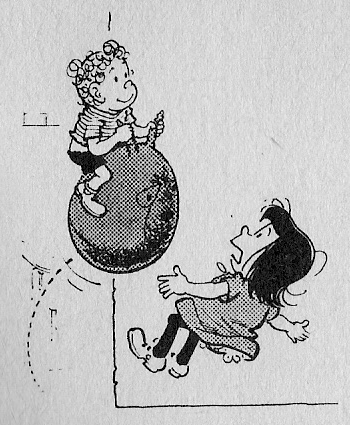
The Spacehopper - 1960s Pop Culture First & Foremost...
The famous Mettoy space hopper first bounced into the UK in 1968...Many thanks to Mark for this interesting e-mail:
I don't remember the 70s, but the Beeb made a groovy job of them in "The I Love 70s" progs. I'm surprised by things I read on here and on your Spacehopper blog that the spacehopper wasn't released in the 70s. You have a feature on "The Perishers" on Spacehopper and I have some old books of them with Baby Grumpling having a spacehopper around 1973.
I agree with you, Mark - the BBC DID make a groovy job of the 1970s - the only trouble was, a lot of it wasn't accurate.
The spacehopper newspaper ad from 1969 on the "Spacehopper" blog, and its labelling as a "Trend", indicates that the hopper was up and bouncing in Britain well before the end of the 1960s.
The I Love... series had a little tag in the opening titles informing the world that the hopper was released in 1968. But the I Love website states that the first hoppers arrived here in 1971 - or at least it did the last time I looked!
The Toy Retailers Association (formerly the British Association of Toy Retailers) was listing Clackers as the "overwhelming toy mania of 1971" - until the I Love 1970s series, when the association joined the merry chorus, labelling the hopper a new arrival and "Craze of the Year" for 1971. This was done recently. The BATR had no "Craze of the Year" award in 1971. Nor any other year.
And as for Baby Grumpling - true he did get a hopper c. 1972 or 73, but Perishers writer Maurice Dodd wrote in the introduction to Omnibus No 3:
Some little time ago I introduced a space hopper, which is an inflatable toy, into the strip. That toy had been hopping around my house for about five years until, when my children had outgrown it, I gave it to my Godson. It was only when I saw him enjoying it I recognised it as a potential runner in the giggle stakes and gave one to Baby Grumpling.
So, the space hopper had been around Mr Dodd's house for about five years when he introduced one into The Perishers strip in 1972/3. Work it out.
An acquaintance of mine contributed some items to the I Love 1970s series. He was astounded that most of the researchers were too young to remember much, if any of the 70s, and suggested that, anyway, the 60s would be a better decade for the series. He was informed by one young researcher that they were too far back, and nobody remembered them!
So, instead, the researchers transplanted 60s pop culture into the 70s.
My acquaintance advised about an item lined up for the 70s series:
"Er, I think you'll find that's 1980s pop culture. It was released in 1980."
"Too late now, it's scheduled," he was told.
So some 80s pop culture tumbled into the 70s black hole too.
I hope an image of the real 70s will emerge here on this blog, and spacehoppers may well be part of it as they continued to be popular after the 60s, but the type of thing purveyed by the BBC or Toy Retailers Association about the spacehopper is not accurate and as this blog is based on actual material from the 70s, has no place here.
Having said that, Mark, you might find other reasons to love the 70s, not based on BBC fantasy! I hope that doesn't sound patronising. It's not meant to be.
I'm absolutely fascinated, as I wade through a mountain of magazines, newspapers and other bits and bobs, to recall my 70s childhood and to see a wider picture of the decade beginning to emerge.
Nostalgia based on accurate info is illuminating and fun!
I hope that you will enjoy the true picture.
Sunday, October 15, 2006
The 1970s: What the BBC Says and the Truth...
The BBC, Wikipedia and others certainly have spread a lot of nonsense about the 70s - although I don't think most of it has been intentional fib-telling! People are just desperate to be nostalgic, and as the 60s are a little way behind us now, and the 80s are tarred as totally greedy, a lot of 60s and 80s pop culture has been wrongly celebrated as "70s".
I will do my best to unmuddy the waters and spread some 1960s fun and information on this blog - http://space-hopper.blogspot.com/
I recommend that 1970s fans do not take too much notice of the BBC's "I Love..." TV programmes or websites, which have been responsible for a great deal of misinformation, or the Toy Retailers Association, which has sadly followed the BBC's lead and altered accurate information on its website to inaccurate! When last I looked, Clackers had been replaced as the craze of 1971 by the spacehopper. The Toy Retailers site states that the hopper arrived in 1971, which is in line with nonsense on the BBC's "I Love..." site. The fact is, our orange friend was featured as a trend in British newspaper advertisements as far back as the late 1960s!
The spacehopper, the Chopper bike, the Stylophone and flared trousers did NOT first become part of British pop culture in the 1970s.
Whilst we're at it, certain other items vaunted as 70s pop culture were actually 80s pop culture! See my 80s blog for accurate 80s info - http://80sactual.blogspot.com/
At the end of the day, nostalgia should be fun, but I can't help thinking that the fantasy 1970s recently created is not a healthy thing at all, as so many youngsters seem to be living in an era that actually did not exist.
This blog aims to celebrate and bemoan the 1970s as they actually were - in England primarily (I have access to a large archive of English provincial newspapers of the era), but people in Wales, Northern Ireland and Scotland, and beyond, will hopefully find that many memories are stirred for them, too.
This is not a boring anorak blog (hopefully), it will be fun as well as informative. But I do aim to be tediously nitpicking about facts and dates. I'm fond of the 1970s - the decade saw me grow from four to fourteen, and whilst it was no picnic, it certainly had its moments.
But the fantasy 21st Century version of the 1970s has outstayed its welcome and should be put to rest.
So, Gaynor, and anybody else who would like a glimpse of the real 1970s, please keep reading - and I'll do my very best!
Sunday, August 07, 2005
1970 - Heath, A Family At War, Page Three, The Goodies, State Of Emergency
On telly, we settled down to a gloomy view of a sandcastle on an overcast beach, Union flag fluttering in the wind... Yes, it was one of the best remembered series of the 1970s - John Finch's A Family At War. This was the tale of an English family, the Ashtons of Liverpool, the story beginning a year or so before the war began and then taking us through it over fifty-two long, long episodes. A Family At War ended in 1972 - the story having finally reached 1945.
The Ashton family fell apart under the strain of the war. Young David Ashton joined the airforce, slept around a lot and led his wife Sheila a dog's life; his parents, Jean and Edwin, fell out when Edwin signed the papers for their youngest son, Robert, to enlist. When Robert was killed, Jean went into a decline and soon died herself... I won't go on.
Don't despair. Not all telly was as grim as A Family At War in 1970: the year saw the start of The Goodies. This show was 1960s-style zany, reminding me of The Monkees, and often providing welcome relief from the enveloping gloom of the 1970s.
So, what music thrilled us? As a tiny wee tot of five, I loved a song called Sally by Gerry Monroe, a cover of Gracie Fields' 1930s original, and Norman Greenbaum's Spirit In The Sky, which charted in March. This song was actually so incredibly 1960s that when it was covered in 1986, one of the members of Dr and The Medics confessed to being very "into" the 60s and dressing to fit the era, although, he assured us, his underpants were from 1982!
It's difficult to estimate the huge influence the 1960s scene and 1960s pop stars had on the 1970s. Excellently funky James Brown had been around for several years when his Get Up I Feel Like Being A Sex Machine charted in 1970. The song had everything to do with the funky, free-lovin' 1960s, and not a lot in common with the grim realities of the new decade.
The Beatles officially broke up and Jimi Hendrix died.
What toys did we play with? I don't recall playing with anything that was "new out" in 1970, but we continued to adore Spirograph and Spacehoppers, both of which had been around for a few years.
Raleigh had released the first Chopper bikes in England in September 1969, but they wouldn't become a craze for several years.
The Raleigh Chopper & Chipper - "A Bicycle Isn't Just A Plaything"...
The Chopper bike, much loved 1970s icon was, of course, actually a 1960s design and arrived here in September 1969, having been launched in the USA in 1968. Here is an ad from October 1970...Raleigh know what youngsters go for - Hot rod looks - rakish frames - The power and pounce you see on a racing circuit.
Packed with action features!
Like hi-rise 'apehanger' bars. Drag style saddle. Snap-action gear shift. And coil spring suspension. All promising the hottest ride you'll ever know.
I remember the Chopper (8 years upwards) of course - who doesn't - but not the Chipper (6 years upwards).
The Chopper did not really take off for a year or two yet, so more later. For some 1969 Chopper bike ads see here.
16/12/1970 - what's coming up on telly tonight?!
The first of three novels, for fans of the telly series. Oh no, sorry, the blurb on the back reads: But a wider readership than those who followed the TV episodes will enjoy this book as an excellent piece of story-telling on its own - a fine example of the English family novel, which will never fail to appeal.Did you know that the actress who played Jean, Shelagh Fraser (pictured on front and back covers of the book), also appeared in the first Star Wars film in 1977? I spotted her straight away and returned from the cinema to tell my incredulous mother that "that woman from A Family At War was in Star Wars!"
Mum's response? "Oh, Andy, don't talk daft!" But I was right...
1970 - The Lights Went Out...


Headlines and articles - December 8th, 1970.It was a grim time. Fortunately, we cooked on gas so meals were not interrupted, but the power cuts were a pain. A local shop caught fire because of enforced candle power. I remember my mother holding up a candle to the blank telly screen during a power cut, and telling me that the light would reveal "what they're doing in there!"
I don't know if she seriously believed that I thought the people we saw on screen were actually inside the set - even at that age I didn't. But she was, and is, a very whimsical person so I indulged her by nodding politely and smiling sweetly!
Saturday, August 06, 2005
The 70s - a Decade of Revivals
The 1970s were a time of recession, and the decade played host to many revivals. The 1950s were huge, 1940s boutiques flourished, platform shoes were dragged out of the 1930s and the 1960s look - flared trousers and all - stuck around and stagnated.Here is a newspaper article from 1971 (Cambridge Evening News, England, UK) detailing the blossoming 50s revival (70s music leant heavily on the 50s - from Roy Wood and Abba to the Sex Pistols).
Later in the 70s, the 60s began to shine again (and we were only just beginning to shake off the 60s flares!) with a revival of interest in the Mods/Rockers and Ska scenes.
Being a child in the 70s has given me a lasting love of 1950s and 60s music!
Friday, August 05, 2005
Archie Street - The Bulldozers Move In...
This little terrace, seen here derelict in 1971, was the inspiration for the original Coronation Street architecture.Back in 1960, with the show in its planning stages, members of the production team toured areas of Manchester looking for a real street which would help them to visualise and bring their fictional street to life. They happened upon Archie Street in the Ordsall district, and the street served as a rough template for the original Coronation Street exterior set (which was built in the Granada TV studios).
Archie Street was also used for some opening title and end credit shots, a small amount of outdoor filming, and was featured on the packaging of a series of early 1960s Coronation Street jigsaw puzzles. More here.
Archie Street was nicknamed "Coronarchie Street" by local inhabitants!
The heyday of the Victorian/Edwardian working class terraced house had apparently long gone by the start of the 1960s (however they became sought after again by the retro-loving "trendies" of the '70s), and many old streets in Manchester were swept away. The local council began moving the residents of Archie Street out in 1968, and the bulldozers arrived in 1971.
St Clement's Church, to the far left of the picture, remains and is still an integral part of the local community.
There is an Archie Street in Salford today, but it is not on the site of the original street, which now contains the modern houses of the St Clements Drive/Buckfield Avenue area.
Discovering the location of the original Archie Street took some detective work on my part. Surely it was on the site of the present day Archie Street in Salford? But I wasn't satisfied with that, having read in HV Kershaw's 1981 autobiography, The Street Where I Live, that Archie Street had been demolished to make way for high rise blocks of flats. There were none in the modern day Archie Street.
The discovery of St Clement's Church at the end of the street in the photograph provided me with the essential clue - was the church still there? It was, of course, and hey presto, the site of the original, inspirational Archie Street terrace was revealed - not, after all, occupied by high rise flats, although there are some not far away.
Incidently, the commercial property on the corner of the original Archie Street, used as a model for Coronation Street's corner shop, was actually an off-licence, and the street had another claim to fame: English footballer Eddie Colman, one of "Busby's Babes" who died in the 1958 Munich air crash, was born there.
A Family At War - To The Turn Of The Tide - Wallowing In The Depths...
1971 brought the second of the three A Family At War novels. Here's a brief extract:It seemed to him [Edwin] that there was nothing left between them. No decency, no humanity, nothing that he believed in and that he had tried to live by.
It seemed to him to be a string of lies, a perpetual line of pretences and petty feuds.
An empty shell.
His family like lost people wandering around in the desert, miles away from each other, with the sun beating down slowly killing them, drying them out until they were shrivelled up into tiny balls of skin and bone.
And all of them having them lost the will to live.
War does terrible things to people, nobody would want to pretend otherwise, but there was no evidence in the book of the wartime spirit my grandparents told me about - of people helping each other.
Thursday, August 04, 2005
The Magic Roundabout - Children As Consumers...
A Corgi Magic Roundabout train with Mr Rusty on board arrives. But not for me. I also remember a wonderful Corgi Magic Garden, complete with the Roundabout, Florence, Dougal, Brian, Dylan, Ermintrude etc in our local newsagent's, staring at me from a glass display cabinet every time I went in. Lord knows how much that cost!If I remember rightly, the Corgi Magic Roundabout train cost 50p, and that was a lot of money to my parents. I used to have intense dreams about owning a Magic Roundabout train toy, and wake up feeling terribly disappointed.
I loved the Magic Roundabout with a passion, right from my tiny tot days in the late '60s, but there was a huge array of merchandising which, heart-rendingly, I couldn't have. On sale were Dougal house slippers, Magic Roundabout lampshades, Magic Roundabout biscuits, Magic Roundabout wallpaper, Magic Roundabout plastic figurines, Magic Roundabout clocks, Magic Roundabout tea towels, Magic Roundabout curtains, Magic Roundabout mattresses, Magic Roundabout cuddly toys, Magic Roundabout annuals, Magic Roundabout storybooks, Magic Roundabout colouring books, Magic Roundabout key rings, Magic Roundabout dot-to-dots, Magic Roundabout crockery, Magic Roundabout tablecloths, Magic Roundabout soap, Magic Roundabout bubble bath, Magic Roundabout umbrellas. And the aforementioned Corgi miniature Magic Garden. Have I missed anything? Loads, I imagine.
The concept of children as consumers was certainly not invented in the 1980s.
I used to be bought a packet of Magic Roundabout biscuits each week (they tasted like malted milk) - and was thrilled by the free plastic Magic Roundabout figures that came with them, one to a packet. Mum saved up the tokens and sent for the whole set. I was so chuffed on the morning I received them that I decided to take them to school, and was so engrossed examining each plastic figure as I walked along that I was nearly run over by a car!
Boy, did the driver swear at me! Fortunately, even as a seven-year-old, I'd heard it all before!
My mum took me to see the film, Dougal and the Blue Cat, and the scene with the Magic Garden folk imprisoned by Buxton the Cat nearly had me in tears. Especially the sight of poor Florence, in chains, crying her little heart out. I had a crush on Florence. I remember opening my eyes very wide and telling myself I musn't cry. Boys didn't cry back then.
The Magic Roundabout was, of course, famous for being 1960s psychedelic style colourful, but we couldn't afford a colour telly.
I never really grew out of the Magic Roundabout, but my parents did not believe that boys over the age of eight-years-old should be interested in puppet series - they thought it was "cissie". The (for me) brilliant wit of the Roundabout did not seem to appeal to them, so I watched whenever I could, whilst pretending to read a book or whatever when my parents were in the room.
The show ended in January 1977 but was sometimes shown as repeats on school holiday mornings for years afterwards.
Eric Thompson died in 1982.
In the Nostalgic 90s, the Magic Roundabout came back in vogue and I discovered that I shared my birthday with it. Eric Thompson's English version (he had placed his own spin on the original French animation by Serge Danot) was first broadcast on 18/10/1965 - about an hour after I was born!
When I discovered our shared debut date, I thought it was a weird coincidence. The show meant a lot to me as a child and saw me through some harsh times. On the way back from a birthday night out, c. 1992, belly full of Stella Artois, feeling heavily sentimental, I stopped in a darkened subway, lifted my eyes to the heavens and thanked Eric Thompson for Ermintrude and co.
Sometimes we do things when we are drunk that seem absolutely ridiculous when viewed through the evil realities of next day's hangover. But my thank you to Mr Thompson seemed then, and still seems today, entirely justified.
"Soppy thing!" as Dougal might say...
Saturday, January 08, 2005
The Great Sykes Revival...
Eric has a moment of misery, but Hattie sees the funny side.The original Sykes series began in 1960 and ended in 1965.
In 1972, the series was revived with Eric Sykes and Hattie Jacques reprising their roles as twins sharing a house in Sebastopol Terrace, Acton, and Richard Wattis as their prissy neighbour, Charles Fulbright Brown.
Later, local magistrate Miss Rumbelow (Joy Harington) took over Mr Brown's role as next door neighbour. Deryck Guyler, who had also appeared in the 60s series, was highly popular as Corky the policeman (hear his voice in a famous 1980s ad series here), and Joan Sims, as Madge from the breadshop, made occasional appearances. Madge dreamt of getting Eric ("Ricky") to the altar!
The 2000 book Sykes of Sebastopol Terrace, tells us:
A revival of "Sykes" was set up by the BBC during the Spring of 1972, and it was quickly agreed that the series would be both colour and far longer than any past seasons. With 16 episodes to fill, it was agreed that Sykes would basically rework old plots to fill the new quota....
They're the same stories retold for a different audience.
Mr Brown has Sykes dancing attendance after injuring his ankle in 1961...
... and again in the 1970s!Sykes was a very welcome revival, which ran until 1979. Hattie's death in 1980 put paid to hopes for further episodes.
Other 1970's revivals of 1960s series included: The Rag Trade, Till Death Us Do Part, The Saint, Oh Boy, Juke Box Jury, The Avengers and Steptoe and Son.
More about the original 60s Sykes here.
Wednesday, January 05, 2005
Beryl's Lot
From Yorkshire Television came this London-based comedy drama, which ran from 1973-1977.Remember that theme tune?
"La-la-la-la-la-la..."
Beryl Humphries (Carmel McSharry), a Battersea milkman's wife, mother-of-three grown-up children, and char, woke up to the prospect of her 40th birthday and decided to broaden her horizons at evening classes.
Husband Tom (Mark Kingston) was happy with his milkround (oh nostalgia - in episode one, an advertisement on his milk float read "It's All At The Co-op" - remember the TV ad jingle: "It's All At The Co-op NOW!") and the odd tip from local bookie Wacky Waters, but accepted Beryl's wish to get educated.
Tom and Beryl's lodger, and soon to be son-in-law Fred (Robin Askwith), worked for Wacky Waters. Fred rode off into the sunset with the Humphries' daughter Rosie at the end of series two, and cinema-goers saw a lot more of Robin Askwith (literally) in the Confessions films.
Trev (Tony Caunter, later Roy of EastEnders) and Vi (Barbara Mitchell) Tonks were the Humphries' neighbours. Trev kept a low profile, whilst gossipy Vi galumphed around the neighbourhood, putting her foot in it. Vi became quite affected by Beryl's efforts to better herself and, following Beryl's lead, began to read books. However, doomwatch literature of the time and her difficulty in keeping things in perspective drove Vi to contemplate suicide. She had a nervous breakdown and was admitted to a psychiatric hospital. Fortunately, Beryl's desire to broaden her horizons did not always have such a negative effect on her friends and neighbours, but it did cause something of a stir!
She rose from the position of kitchen maid to cook during her time in service, before meeting and marrying Albert Powell.
Having three sons who had all won scholarships to grammar school, Margaret decided to brush up her education at evening classes so that she would be able to converse with them. She went on to take O and A levels.
She was discovered in the mid-1960s when Leigh Crutchley from the BBC took her from a discussion group and invited her to talk about her life. This led to her BBC debut.
Margaret, who had a charming personality, a great sense of humour and honesty, and a very infectious and distinctive giggle, became an authoress, writing several books about her life and travels, and TV and radio personality.
Appearing on everything from Woman's Hour and Blankety Blank to a Paxo stuffing advertisement, Margaret was greatly loved.
She died in 1984.
In the 1970s and early-to-mid 1980s, just about every TV series/serial was accompanied by a series of novels. Video recorders were rare and expensive beasts (only 5% of UK households had them by 1980), so novels filled the gap later occupied by videos.Beryl's Lot had three novels to accompany it, by Margaret Powell, "with" Lee McKenzie, who apparently wrote tough crime thrillers under another pseudonym!
The cover of the third and final Beryl's Lot book states that it is: "Based on a series originated by Kevin Laffan".
It's All At Your Co-op Now!
"It's all at your Co-op NOW!"I heard that TV ad jingle (which actually began in the 1960s) so many times, it feels like part of me! This newspaper ad shows some of the brilliant bargains filling the Co-op shelves for Christmas 1973...
Things look amazingly cheap here - but don't be fooled - people earned a lot less, and decimalisation and inflation meant rapid price rises.
It really was an anxious time. My mother wore a worried frown on shopping trips, as she fumbled in her purse for enough money to cover the price increases since her last trip. With over a million unemployed, my stepfather sweated over his job security.
And belts were pulled in across the land. There were party decades and hangover decades, we were told - and, in this case, the "swinging" 60s had been the party and we were now suffering the hangover.
Good to see Ronnie Corbett in the ad here - he was my favourite of The Two Ronnies. As for the products on display, where do I begin?!
We never drank coffee. My cosmopolitan grandmother did, but my stick-in-the-mud mother didn't - she considered it "foreign" (tea isn't, of course!) and too expensive. And we were as poor as church mice, like a lot of people in the 1970s. Every penny counted.
The Sutherlands Beef Spread makes me smile. We used to have a lot of paste sandwiches when I was a kid - not Sutherlands, though - it was too "dear"!
"What's for lunch, Mum?!"
"Paste sandwiches!"
"What's for tea, Mum?!"
"Paste sandwiches!"
Remember this telly ad jingle?
"Crawfords Cheddars - round and tempting, rich and golden, cheddar cheesy, Crawfords Cheddars, more than thirty, you'll keep coming back for just one more..."
They were YUM!
Crisps were different then. Not as crisp and light, often brown or green hued, and not as delicately flavoured. And Jaffa Cakes! Right from being a tiny tot in the late 1960s, I was the Mad Jaffa Cake Eater of our household.
Funny to look back. My diet underwent a sudden change in the mid 1980s, when fancy foods and dressings suddenly loomed large at my local supermarket and there was a bit of money around, but in the 70s and early 80s we stuck to what we were used to.
And it was very nice.
Most of it.
Milk
Saturday Cat
Commercial Break...
1973: It's "All Bad News"!
More power cuts - and lashings of other grotty tidings in December 1973.I enjoyed this round of power cuts. They broke up the routine, and I loved the candles, which emphasised our nictotine-stained ceilings and made my mother wail at my stepfather: "Fred! It's time you sorted those ceilings out!"
He'd grunt from behind his newspaper, and nothing would be done. They both smoked like troopers, although there was increasing awareness of the health risks - indeed cigarette advertising on ITV had been banned since 1965.
I remember during one power cut, my mother sent me to the local shop for some tea. I walked through the streets, staring around in wonder. Some windows were showing tiny points of glowing candlelight, most were dark. I was awed by the darkness of it all.
I don't recall electric tills being around at all in those days - and this was fortunate because manual shop tills were unaffected by the power cuts. Our local shop had candles dotted strategically about, and I bought the tea thinking: "Isn't this exciting? What an adventure!"
I was eight at the time.
Mum had the kettle on when I arrive home, and called from the living room: "Put the tea in the caddy and a couple of spoonfuls in the pot." We always had loose tea then. Mum didn't like bags - she said they "tasted".
So excited by the power cut was I that, somehow or other, I managed to pour the whole packet of tea into the pot, without realising.
It was the worst tea we'd ever tasted, and my exciting, adventurous evening ended with a "ding round the ear 'ole" and bed.
Sunday, November 28, 2004
1976: Fanny Cradock Comes Unstuck...
1975: "Fanny Cradock Cooks For Christmas" - seasonal fare for the cash-strapped 1970s.
1976: "The Big Time" - Fanny registers absolute disgust at the suggested menu of an amateur cook. Big Time? Big Mistake.French cookery was the be-all-and-end-all to Fanny, as it was to many at that time, and La Cradock was proud of having some French ancestry a little way back. Fanny seemed to believe that French and English were not simply different nationalities, but different races - particularly when it came to culinary skills!
She was posh and bossy, could wear wonderful finery whilst cooking without getting covered in flour, and was one of the most enjoyable TV personalities I have ever clapped eyes on. To watch Fanny and Johnnie, she the Iron Lady, he the silly dodderer, was to watch a wonderful double act. The entertainment value went way beyond the cooking.
Perhaps blue eggs do seem a bit weird now, but hey, this was the rock n’ rollin’ 50s and the free lovin’ 60s! Things were different!
By the time the 1970s had arrived, Fanny had been HUGE for years, and it seemed that she would go on forever. I loved watching her as a little kid, although when I was a tiny tot I had found her a little creepy. I think this was because her voice sounded quite male, and she wore loads of make-up.
In 1975, Fanny Cradock Cooks For Christmas showed that our culinary heroine had her finger firmly on the pulse of current economic trends, as she prepared meals like mincemeat pancakes for Christmas jollies and mentioned many times the appalling economic climate. With prices soaring, I recall my mother being grateful for Fanny’s cost-cutting approach back then.
Then, in 1976, Fanny disgraced herself. She poured scorn on a menu presented by an amateur cook on the BBC TV show The Big Time. So biting and condescending was Fanny that her career was permanently damaged. Neither the viewing public nor the BBC admired her approach, and Fanny rarely appeared on television again. In the 1980s, she could be glimpsed at times on chat shows and breakfast TV publicising various books she was writing, as spirited as ever, but her career as a TV cook was over.
Fanny Cradock died in 1994, and although she wasn’t the most lovable of TV personalities, she was certainly a trailblazer for TV cooks.
And enormously entertaining to watch.
Every year, just before Christmas, my wife and I settle down to watch Fanny Cradock Cooks For Christmas. It stirs memories of “making do” at Christmas in the 1970s, and Fanny never fails to delight us. When watching the shows, it is always hard to believe that the vibrant, colourful personality on screen is no more.
Thursday, September 30, 2004
70s Top of the Pops: Come on baby do the juke box jive...
This is a snippet from my local newspaper the Cambridge Evening News, dated 10/12/1977. It's interesting (if you happen to live in mid-Anglia) to see what was on in the "What's On" section (the Spinners! Wow!), but the main reason for the inclusion of this little snippet is the TV review.Do you mourn for the days when the pop charts were full of mind-blowingly innovative, totally new, totally THRILLING stuff?
Er... just when exactly was that?
Our local rag's TV reviewer back in 1977, Crawford Gillian, had a hate/hate relationship with TOTP. I've copied the review below, as the original is a little on the faint side in parts.
Ten-year toppers
About 10 years ago, "Top of the Pops" was a Thursday night "must" for me.
It was an easy way to keep an eye on the pop end of the music scene. And for good measure, if you will excuse such a tasteless pun, there were always Pan's People - suitably undressed.
In those days, you could expect to see such giants of the pop world as Paul McCartney, Manfred Mann or the Bee Gees.
On Thursday last week I tuned into "Top of the Pops" for the first time in ages and on the show were... Paul McCartney, Manfred Mann and the Bee Gees! Pan's People were still there, or at least their younger sisters. But now they're called Legs and Co.
Even the camera angles looked the same. There is still the lingering close-up of the pianist's fingers, the shots in negative, melting into others aimed directly into coloured spotlights. Of course, in 1967, we didn't know they were coloured.
The performers respond with the same mock-petulant postures and still don't bother to maintain the pretence of playing their instruments.
Women's Lib doesn't seem to have penetrated the pop world. There was the statutory girl draped round each of Tony Blackburn's shoulders as he introduced the groups, purely decorative.
One exception was a gravel-throated girl singer who looked and sounded like Rod Stewart - another reminder of the sixties influence.
Even the Number One spot looked decidedly dated with Paul McCartney and his jingoistic tribute to the Mull of Kintrye.
It featured a Scottish pipe band marching up and down a beach. Being of the appropriate nationality, I suppose the blood should have been leaping in my veins at such a sight. All it reminded me of was the "Monty Python" sketch with the kamikazee Highlanders throwing themselves one after the other from castle battlements.
If Messrs Cleese and Chapman had got hold of this one, the sequence would have ended with the pipe band marching out to sea.
But that's one of the troubles with "Top of the Pops". It never has had any sense of humour.
Next week Elton John takes on the job of handling the introductions. Another sixties superstar. Need I say more?
The "gravel-throated" singer was none other than Bonnie Tyler with It's A Heartache.
The top ten for the week ending 10/12/1977 was:
1) Mull of Kintyre/Girls' School - Wings
2) Floral Dance - Brighouse and Rastrick Brass Band
3) How Deep Is Your Love - Bee Gees
4) Dancin' Party - Showaddywaddy
5) I Will - Ruby Winters
6) Daddy Cool - Darts
7) We Are The Champions - Queen
8) Rockin' All Over The World - Status Quo
9) Egyptian Raggae - Jonathan Richmond and the Modern Lovers
10) Belfast - Boney M
Sunday, August 29, 2004
Radio Rentals Colour - Highly Superior!
A newspaper advertisement from November 1978. It's great to see the remote control sets, but these wouldn't be making their debut in my family home for several years yet. The reasons? A) lack of money and B) we didn't see the point. Nowadays, of course, I wouldn't stand for a telly without remote control in my house.
In those days, we didn't have a video recorder, either. Only 5% of UK households had them in 1980. Yes 1980 - amazing, isn't it?
Mind you, what you'd never had you never missed and we didn't realise we were living in the dark ages. We rented a colour telly in 1978 (colour had arrived in 1967) , with a coin meter on the back, but we couldn't afford to keep feeding the meter, so we went back to our old black and white set. The horizontal hold was "going" - the picture was a thin band across the screen (people on our telly looked like eggs on legs) - but we were used to it.
And that was how it was until the early 1980s!
I liked the Radio Rentals telly ad (I have so many 60s, 70s and 80s telly jingles lodged in my brain!). "Radio Rentals Colour" was sung, and then a posh female voice (Penelope Keith's?) said: "Highly superior!"
Seems like yesterday...
Saturday, August 28, 2004
1979: Grown-Ups Were Eating "Our" Rice Krispies. Apparently.
It's 1979, and on the telly (pre-strike!!) and in the TV Times a militant boy is on a crusade to stop grown-ups from eating Rice Krispies. Nice little ads - but barbecued Rice Krispies?!Back in the 1970s, my mother dismissed the idea of barbecued food as "foreign muck" so I'd never tried it.
Nowadays I love it, but I think I'll leave out the recipe here.
"Where Are You All Coming From?" The Smurfs Arrive!
This is your "Smurf of the Month" at National petrol stations, July 1979. The Smurfs' orgins actually date back to the late 1950s, but over here in England most of us had never heard of them until they released a pop record called The Smurf Song, which crashed into our pop charts on 10/6/1978."Where are you all coming from?" asked Father Abraham.
"From Smurfland where we belong!" they warbled in reply.
The song made it all the way up to No. 2.
Of course, there was a spoof version:
"Where are you all coming from?"
"We're from Brixton, on the run!"
Smurf merchandising was everywhere - cuddly toys, books, figurines...
The original Smurf craze in England outlasted the 1970s, spilling over into the early 1980s.
Lovely.
1979: Proudly Presenting Mr Shakin' Stevens...
IT COULD BE A SHAKING REVIVALFrom the TV Times, July 1979.
Shakin’ Stevens - known to his friends as Shaky - is a miner’s son from Cardiff who is rising to fame on the rock ‘n’ roll revival. From playing Elvis Presley on stage in the London hit musical “Elvis”, he’s now shaking up “Oh Boy!” on Monday evenings.
He doesn’t see himself as an out-and-out rocker. “I mean,” he says, “I’ve never worn Teddy Boy clothes. Never been a Ted. Never wore creeper shoes. I’m more casual. You don’t have to plaster your hair with grease to like the music. That’s the trouble - everyone’s putting everyone else in compartments. I’m just Shaky Stevens, rock artist.”
He says it’s always the same in the music business - fashions keep changing, but rock music stays much the same. Jack Good, who created this series of “Oh Boy!” as well as the original twenty years ago, agrees. “Music goes round in ever decreasing circles. Fashions come and go but the sounds still keep turning up again.”
Good is 47. Perhaps, he says, it’s a little too old to still be messing with rock ‘n’ roll but he’s not that bothered. “I don’t think it’s any more mature to play “Hamlet” rather than play “Whole Lotta Shakin’ Goin’ On”.
Viewers of this series of “Oh Boy!” aren’t just entertained by the rock ‘n’ rollers on stage, but by the committed, specially invited Teddy boys and girls in the audience.
Now that audience really DOES believe in the fashion. Take Barry Rodgers, aged 28, from Selly Oak, Birmingham. He is a Teddy boy and proud of it; his two best suits prove the point. One’s black and edged with silver-grey velvet, the other is blue drape set off with mauve. Sometimes he wears a bootlace tie, but basically, says Barry, he’s a “slim Jim” man. His wife Ann is a Teddy girl. “Our interests, our beliefs, brought us together. Ann wears stiletto heels, full circular skirt, suspenders, stockings and pony tail. She looks great.”
“One day,” says Barry Rodgers, who goes to his job as a fitter dressed in all the gear, “we’ll have a little Teddy boy or Teddy girl. And they’ll be wearing drainpipe nappies.”
The 70s had a huge love affair with the 50s.
Think Fonzie.
Roy Wood and Wizzard
Grease
Certain Abba songs, like Waterloo
The repeated 1950’s guitar riffs on certain Punk records
Showaddywaddy
Mud
The Crocodile Rock
The Rubettes
The Bay City Rollers (with their “blue suede shoes, dancin' the night away”)
It could be annoying because watching Top Of the Pops in the 70s was a nightmare for me. My mother, who had been very much part of the 50s scene, always punctuated the show with squawks of “We did that! They’re copying us!”
But what the heck. Because of my 70s childhood I grew to love 50s (and some 60s) music.
And I’m glad.
"TV Times", July 1979 - we Love the 50s and 60s. 70s 50s retro pop star Alvin Stardust and his 60s mate Joe Brown welcome us back to two great musical decades.What else can you see of interest in this TV Times clipping?
Clapperboard sure bored me.
Why Can't I Go Home? was great. It was aimed at kids a bit younger than me, so I watched it whilst apparently "doing my homework".
Crossroads was deeply into the hellishly long story of Alison Cotterill, her gloomy uncle Reg, her facial scar, her plastic surgery, etc, etc...
Jenny Tomasin, Ruby of Upstairs, Downstairs fame, was appearing as a character called Florence Baker. I vaguely recall Jenny appearing in Crossroads (not that I ever watched it, of course), and, if I remember rightly, her character in the motel saga was not a million miles away from Ruby.
Coronation Street was going great guns, now well into the Bill Podmore era.
And yellow dentures?!! I'll pass on that.