
I find it fascinating that the 1970s are so widely vaunted as "The Golden Age Of Television". Can somebody please explain? For instance, the BBC's "I Love The 1970s" site places Monty Python in 1970.
It began in 1969.
"Ah," say '70s fans," but it was at its height in the early '70s!"
Oh, I see.
Not The Nine O'Clock News was "at its height", and indeed had the line-up we all remember, in the early 1980s.
But it appears on the BBC "I Love The 1970s" site on the 1979 page.
"Ah," say '70s fans, "But it BEGAN in 1979."
Um... er... does not compute.
Meanwhile, let's not forget the 1970s had its fair share of dross (Take The Wife or Rings On Their Fingers, anybody?).
And for every The Sweeney there was a few dozen flops.
And didn't the 1960s and 1980s also have lashings of memorable and innovative TV shows?
I think they did.
Do we reject the 1960s because the shows were largely in black and white?
Do we reject the 1980s because it was the era of Thatcher and Reagan?
The "Golden Age of Coronation Street" is also apparently the 1970s. But the show slipped catastrophically in the ratings in the early '70s! And I find many of those episodes unwatchable. Things perked up brilliantly when Bill Podmore became producer in 1976, but that hardly qualifies the WHOLE of the 1970s as being the "Golden Age" of Corrie, does it?
The '70s had some great TV.
It also had loads of trash.
Rather like the 1960s and 1980s.
So, people, please try and CONVINCE me otherwise, please! Try to make me see what you see.
And comments such as:
"70s woz great, wot are you talking about?" will not be published.
Showing posts with label TV. Show all posts
Showing posts with label TV. Show all posts
Tuesday, September 01, 2009
Thursday, November 23, 2006
"Yes, Mrs Walker!" The Rovers Return, 1970-1979
 Signed photograph showing Doris Speed as Annie Walker, Mayoress of Weatherfield.
 Inscription on the back of the photograph.
The Rovers Return Inn, Coronation Street, underwent several changes in the 1970s, not to mention copping its fair share of everyday comedy and drama.
In 1970, Arthur Leslie, who played landlord Jack Walker, died. Much loved as the kindly and long suffering husband of snobbish Annie, there was no chance of the role being recast. And so Jack died too - on a visit to his daughter Joan.
Annie remained and the decade contained a mixed bag of fortunes for her.
She disapproved when son Billy appointed “common” Bet Lynch as barmaid in 1970.
She became mayoress of Weatherfield to Alf Roberts’ mayor, and took elocution lessons in 1973.
She was terrorised by two hooligans who hid in the Rovers loos at closing time and emerged after the rest of the staff had gone home in 1975.
She fought against Renee Bradshaw’s plans to open an off-licence at the Corner Shop, and lost in 1976.
She learned to drive and bought a Rover 2000 car - also in 1976. Of course, having learned to drive, being Annie, she rarely did. She much preferred being chauffeured by Rovers potman Fred Gee!
She suffered a terrible trauma when a lorry crashed into the front of the Rovers in March 1979 after the driver had a heart attack at the wheel.
Doris Speed was a true original, basing her characterisation of Mrs Walker on her Aunt Bessie, who used to lead the family at charades at Christmas and had a withering look to bestow on those who mocked.
Unlike Mrs Walker, Doris was a staunch socialist and possessed of a splendid sense of humour, telling endless hilarious anecdotes, often against herself.
Annie, the snob supreme of the Street, could have been hated by viewers, but the excellent acting of Doris Speed, and some terrific scripts, prevented it. There were times when we could have cheerfully throttled her, but other times when we were deeply concerned for the character.
I remember me and my family, all sitting around the telly with lumps in our throats, feeling terribly sorry for Mrs Walker after her son Billy had laid into her over her interference in his relationship with Deirdre Hunt. Annie had interfered because she truly believed that Deirdre was not good enough for her son. Once she had been found out, nobody could fail to be affected by Doris Speed’s performance as Billy told Annie that he never wanted to see her again.
What was clear about Annie was that she never acted out of “cartoon baddie” motives. She sincerely believed that what she was doing was for the best.
When Bet upbraided Annie for opposing Renee Bradshaw’s application for an off-licence, accusing her of doing so out of grandiose pretentiousness and a selfish determination to keep the Rovers as top dog for drinkers in the neighbourhood, Annie was shocked and hurt that Bet and many of her regulars believed this to be true. She explained, with obvious sincerity, that she had simply acted out of love for the Rovers.
I don’t watch Coronation Street now, but I recall episodes some years ago when Maureen Lipman played an Annie Walker-style bar manageress. Rita Sullivan commented that the Rovers was no place for a snob like her.
Oh, Rita, I thought, what a short memory you have!
It was a snob that gave the Rovers its highly distinctive atmosphere and many of its finest storylines, from December 1960 to October 1983.
Cheers, Annie!
-
 Two sides of a Rovers Return Newton and Ridley beermat, sent to me by Granada Televsion, c. 1978. These were in use in the programme in the late 1970s and early 1980s.

Sunday, August 07, 2005
1970 - Heath, A Family At War, Page Three, The Goodies, State Of Emergency
The 1960s were never going to be an easy act to follow and so, as we entered the new decade, we found that "last year's styles are good for 1970". Edward Heath became Prime Minister in June, meaning that the Tories were back in power. Shortly afterwards Mr Heath, he of the hearty chuckles and bouncing shoulders, declared a state of emergency when the dockers went on strike.
On telly, we settled down to a gloomy view of a sandcastle on an overcast beach, Union flag fluttering in the wind... Yes, it was one of the best remembered series of the 1970s - John Finch's A Family At War. This was the tale of an English family, the Ashtons of Liverpool, the story beginning a year or so before the war began and then taking us through it over fifty-two long, long episodes. A Family At War ended in 1972 - the story having finally reached 1945.
The Ashton family fell apart under the strain of the war. Young David Ashton joined the airforce, slept around a lot and led his wife Sheila a dog's life; his parents, Jean and Edwin, fell out when Edwin signed the papers for their youngest son, Robert, to enlist. When Robert was killed, Jean went into a decline and soon died herself... I won't go on.
Don't despair. Not all telly was as grim as A Family At War in 1970: the year saw the start of The Goodies. This show was 1960s-style zany, reminding me of The Monkees, and often providing welcome relief from the enveloping gloom of the 1970s.
So, what music thrilled us? As a tiny wee tot of five, I loved a song called Sally by Gerry Monroe, a cover of Gracie Fields' 1930s original, and Norman Greenbaum's Spirit In The Sky, which charted in March. This song was actually so incredibly 1960s that when it was covered in 1986, one of the members of Dr and The Medics confessed to being very "into" the 60s and dressing to fit the era, although, he assured us, his underpants were from 1982!
It's difficult to estimate the huge influence the 1960s scene and 1960s pop stars had on the 1970s. Excellently funky James Brown had been around for several years when his Get Up I Feel Like Being A Sex Machine charted in 1970. The song had everything to do with the funky, free-lovin' 1960s, and not a lot in common with the grim realities of the new decade.
The Beatles officially broke up and Jimi Hendrix died.
What toys did we play with? I don't recall playing with anything that was "new out" in 1970, but we continued to adore Spirograph and Spacehoppers, both of which had been around for a few years.
Raleigh had released the first Chopper bikes in England in September 1969, but they wouldn't become a craze for several years.


 16/12/1970 - what's coming up on telly tonight?!
 The first of three novels, for fans of the telly series. Oh no, sorry, the blurb on the back reads: But a wider readership than those who followed the TV episodes will enjoy this book as an excellent piece of story-telling on its own - a fine example of the English family novel, which will never fail to appeal.
Did you know that the actress who played Jean, Shelagh Fraser (pictured on front and back covers of the book), also appeared in the first Star Wars film in 1977? I spotted her straight away and returned from the cinema to tell my incredulous mother that "that woman from A Family At War was in Star Wars!"
Mum's response? "Oh, Andy, don't talk daft!" But I was right...
Friday, August 05, 2005
Archie Street - The Bulldozers Move In...
 This little terrace, seen here derelict in 1971, was the inspiration for the original Coronation Street architecture.
Back in 1960, with the show in its planning stages, members of the production team toured areas of Manchester looking for a real street which would help them to visualise and bring their fictional street to life. They happened upon Archie Street in the Ordsall district, and the street served as a rough template for the original Coronation Street exterior set (which was built in the Granada TV studios).
Archie Street was also used for some opening title and end credit shots, a small amount of outdoor filming, and was featured on the packaging of a series of early 1960s Coronation Street jigsaw puzzles. More here.
Archie Street was nicknamed "Coronarchie Street" by local inhabitants!
The heyday of the Victorian/Edwardian working class terraced house had apparently long gone by the start of the 1960s (however they became sought after again by the retro-loving "trendies" of the '70s), and many old streets in Manchester were swept away. The local council began moving the residents of Archie Street out in 1968, and the bulldozers arrived in 1971.
St Clement's Church, to the far left of the picture, remains and is still an integral part of the local community.
There is an Archie Street in Salford today, but it is not on the site of the original street, which now contains the modern houses of the St Clements Drive/Buckfield Avenue area.
Discovering the location of the original Archie Street took some detective work on my part. Surely it was on the site of the present day Archie Street in Salford? But I wasn't satisfied with that, having read in HV Kershaw's 1981 autobiography, The Street Where I Live, that Archie Street had been demolished to make way for high rise blocks of flats. There were none in the modern day Archie Street.
The discovery of St Clement's Church at the end of the street in the photograph provided me with the essential clue - was the church still there? It was, of course, and hey presto, the site of the original, inspirational Archie Street terrace was revealed - not, after all, occupied by high rise flats, although there are some not far away.
Incidently, the commercial property on the corner of the original Archie Street, used as a model for Coronation Street's corner shop, was actually an off-licence, and the street had another claim to fame: English footballer Eddie Colman, one of "Busby's Babes" who died in the 1958 Munich air crash, was born there.
A Family At War - To The Turn Of The Tide - Wallowing In The Depths...
 1971 brought the second of the three A Family At War novels. Here's a brief extract:
It seemed to him [Edwin] that there was nothing left between them. No decency, no humanity, nothing that he believed in and that he had tried to live by.
It seemed to him to be a string of lies, a perpetual line of pretences and petty feuds.
An empty shell.
His family like lost people wandering around in the desert, miles away from each other, with the sun beating down slowly killing them, drying them out until they were shrivelled up into tiny balls of skin and bone.
And all of them having them lost the will to live.
War does terrible things to people, nobody would want to pretend otherwise, but there was no evidence in the book of the wartime spirit my grandparents told me about - of people helping each other.
Thursday, August 04, 2005
The Magic Roundabout - Children As Consumers...
 A Corgi Magic Roundabout train with Mr Rusty on board arrives. But not for me. I also remember a wonderful Corgi Magic Garden, complete with the Roundabout, Florence, Dougal, Brian, Dylan, Ermintrude etc in our local newsagent's, staring at me from a glass display cabinet every time I went in. Lord knows how much that cost!
If I remember rightly, the Corgi Magic Roundabout train cost 50p, and that was a lot of money to my parents. I used to have intense dreams about owning a Magic Roundabout train toy, and wake up feeling terribly disappointed.
I loved the Magic Roundabout with a passion, right from my tiny tot days in the late '60s, but there was a huge array of merchandising which, heart-rendingly, I couldn't have. On sale were Dougal house slippers, Magic Roundabout lampshades, Magic Roundabout biscuits, Magic Roundabout wallpaper, Magic Roundabout plastic figurines, Magic Roundabout clocks, Magic Roundabout tea towels, Magic Roundabout curtains, Magic Roundabout mattresses, Magic Roundabout cuddly toys, Magic Roundabout annuals, Magic Roundabout storybooks, Magic Roundabout colouring books, Magic Roundabout key rings, Magic Roundabout dot-to-dots, Magic Roundabout crockery, Magic Roundabout tablecloths, Magic Roundabout soap, Magic Roundabout bubble bath, Magic Roundabout umbrellas. And the aforementioned Corgi miniature Magic Garden. Have I missed anything? Loads, I imagine.
The concept of children as consumers was certainly not invented in the 1980s.
I used to be bought a packet of Magic Roundabout biscuits each week (they tasted like malted milk) - and was thrilled by the free plastic Magic Roundabout figures that came with them, one to a packet. Mum saved up the tokens and sent for the whole set. I was so chuffed on the morning I received them that I decided to take them to school, and was so engrossed examining each plastic figure as I walked along that I was nearly run over by a car!
Boy, did the driver swear at me! Fortunately, even as a seven-year-old, I'd heard it all before!
My mum took me to see the film, Dougal and the Blue Cat, and the scene with the Magic Garden folk imprisoned by Buxton the Cat nearly had me in tears. Especially the sight of poor Florence, in chains, crying her little heart out. I had a crush on Florence. I remember opening my eyes very wide and telling myself I musn't cry. Boys didn't cry back then.
The Magic Roundabout was, of course, famous for being 1960s psychedelic style colourful, but we couldn't afford a colour telly.
I never really grew out of the Magic Roundabout, but my parents did not believe that boys over the age of eight-years-old should be interested in puppet series - they thought it was "cissie". The (for me) brilliant wit of the Roundabout did not seem to appeal to them, so I watched whenever I could, whilst pretending to read a book or whatever when my parents were in the room.
The show ended in January 1977 but was sometimes shown as repeats on school holiday mornings for years afterwards.
Eric Thompson died in 1982.
In the Nostalgic 90s, the Magic Roundabout came back in vogue and I discovered that I shared my birthday with it. Eric Thompson's English version (he had placed his own spin on the original French animation by Serge Danot) was first broadcast on 18/10/1965 - about an hour after I was born!
When I discovered our shared debut date, I thought it was a weird coincidence. The show meant a lot to me as a child and saw me through some harsh times. On the way back from a birthday night out, c. 1992, belly full of Stella Artois, feeling heavily sentimental, I stopped in a darkened subway, lifted my eyes to the heavens and thanked Eric Thompson for Ermintrude and co.
Sometimes we do things when we are drunk that seem absolutely ridiculous when viewed through the evil realities of next day's hangover. But my thank you to Mr Thompson seemed then, and still seems today, entirely justified.
"Soppy thing!" as Dougal might say...
Saturday, January 08, 2005
The Great Sykes Revival...
 Eric has a moment of misery, but Hattie sees the funny side.
The original Sykes series began in 1960 and ended in 1965.
In 1972, the series was revived with Eric Sykes and Hattie Jacques reprising their roles as twins sharing a house in Sebastopol Terrace, East Acton, and Richard Wattis as their prissy neighbour, Charles Fulbright Brown.
Mr Brown had actually left in the 60's series, as had Richard Wattis, but the new run brought him back to where he belonged - next door to Eric and Hat, and a constant pain in the neck.
After the death of Richard Wattis in 1975, local magistrate Miss Rumbelow (Joy Harington) took over Mr Brown's role as next door neighbour. Sensibly, Eric Sykes didn't write her as a female Mr Brown. She was far more sensible than him and not as funny, but the character worked very well, and provided difficulties for Eric and Hat which led to some very funny situations.
 Dear Mr Brown from next door.
The 2000 book Sykes of Sebastopol Terrace, tells us:
A revival of "Sykes" was set up by the BBC during the Spring of 1972, and it was quickly agreed that the series would be both colour and far longer than any past seasons. With 16 episodes to fill, it was agreed that Sykes would basically rework old plots to fill the new quota....
They're the same stories retold for a different audience.
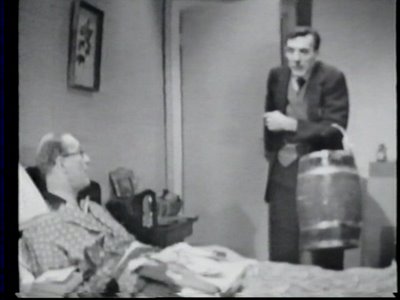 Mr Brown has Sykes dancing attendance after injuring his ankle in 1961...
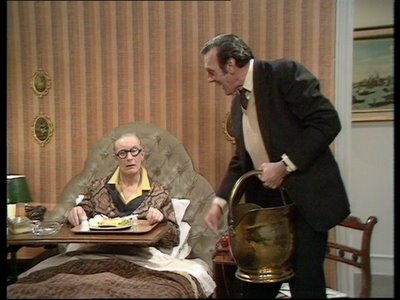 ... and again in the 1970s!
Sykes was a very welcome revival, which ran until 1979. Hattie's death in 1980 put paid to hopes for further episodes.
Other 1970's revivals of 1960s series included: The Rag Trade, Till Death Us Do Part, The Saint, Oh Boy, Juke Box Jury, The Avengers and Steptoe and Son.
More about the original 60s Sykes here.
After the death of Richard Wattis in 1975, local magistrate Miss Rumbelow (Joy Harington) took over Mr Brown's role as next door neighbour. Sensibly, Eric Sykes didn't write her as a female Mr Brown. She was far more sensible than him and not as funny, but the character worked very well, and provided difficulties for Eric and Hat which led to some very funny situations.
Deryck Guyler, who had also appeared in the 60s series, was highly popular as Corky the policeman (hear his voice in a famous 1980s ad series here), and Joan Sims, as Madge from the local bread shop, made occasional appearances. Madge dreamt of getting Eric ("Ricky") to the altar!
This is a series I remember very fondly indeed from my kiddie/early teen years, and I loved Eric, Hattie, Mr Brown, Corky and Madge. Even waspish Mr Brown, who was a pain in the neck, was somehow lovable. His doomed to failure efforts to impress were very sad. And Miss Rumbelow, who could never have replaced Mr Brown, was nevertheless a great addition to the neighbourhood.

The 2000 book Sykes of Sebastopol Terrace, tells us:
A revival of "Sykes" was set up by the BBC during the Spring of 1972, and it was quickly agreed that the series would be both colour and far longer than any past seasons. With 16 episodes to fill, it was agreed that Sykes would basically rework old plots to fill the new quota....
They're the same stories retold for a different audience.
 Mr Brown has Sykes dancing attendance after injuring his ankle in 1961...
 ... and again in the 1970s!
Sykes was a very welcome revival, which ran until 1979. Hattie's death in 1980 put paid to hopes for further episodes.
Other 1970's revivals of 1960s series included: The Rag Trade, Till Death Us Do Part, The Saint, Oh Boy, Juke Box Jury, The Avengers and Steptoe and Son.
More about the original 60s Sykes here.
Wednesday, January 05, 2005
Beryl's Lot
 From Yorkshire Television came this London-based comedy drama (it was NOT a sitcom!), which ran from 1973-1977.
Remember that theme tune?
"La-la-la-la-la-la..."
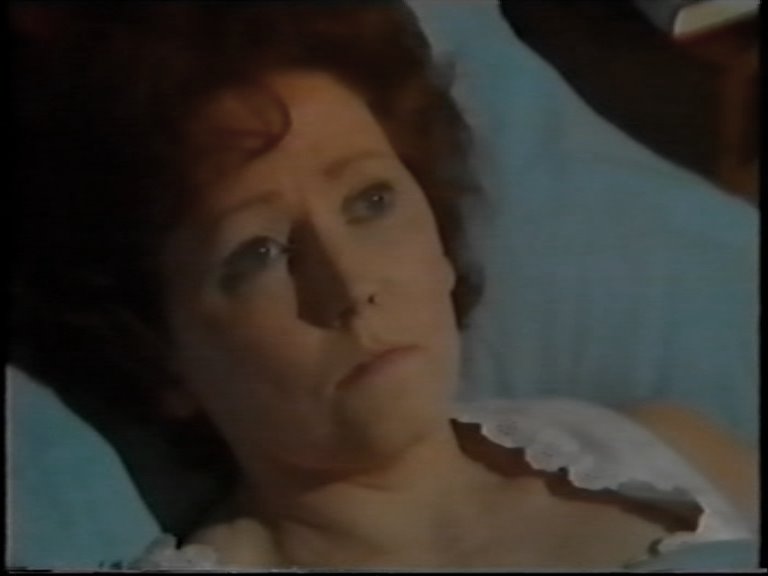 Beryl Humphries (Carmel McSharry), a Battersea milkman's wife, mother-of-three grown-up children, and char, woke up to the prospect of her 40th birthday and decided to broaden her horizons at evening classes.
 Husband Tom (Mark Kingston) was happy with his milkround (oh nostalgia - in episode one, an advertisement on his milk float read "It's All At The Co-op" - remember the TV ad jingle: "It's All At The Co-op NOW!") and the odd tip from local bookie Wacky Waters, but accepted Beryl's wish to get educated.
 Tom and Beryl's lodger, and soon to be son-in-law Fred (Robin Askwith), worked for Wacky Waters. Fred rode off into the sunset with the Humphries' daughter Rosie at the end of series two, and cinema-goers saw a lot more of Robin Askwith (literally) in the Confessions films.
 Trev (Tony Caunter, later Roy of EastEnders) and Vi (Barbara Mitchell) Tonks were the Humphries' neighbours. Trev kept a low profile, whilst gossipy Vi galumphed around the neighbourhood, putting her foot in it. Vi became quite affected by Beryl's efforts to better herself and, following Beryl's lead, began to read books. However, doomwatch literature of the time and her difficulty in keeping things in perspective drove Vi to contemplate suicide. She had a nervous breakdown and was admitted to a psychiatric hospital.
Fortunately, Beryl's desire to broaden her horizons did not always have such a negative effect on her friends and neighbours, but it did cause something of a stir!
-

The fictional story of Beryl Humphries was inspired by the true story of Margaret Powell (née Langley), a milkman's wife and former domestic servant. Margaret originally wanted to be a teacher, but her parents could not afford for her to continue her education to gain the necessary qualifications.
She rose from the position of kitchen maid to cook during her time in service, before meeting and marrying Albert Powell.
Having three sons who had all won scholarships to grammar school, Margaret decided to brush up her education at evening classes so that she would be able to converse with them. She went on to take O and A levels.
She was discovered in the mid-1960s when Leigh Crutchley from the BBC took her from a discussion group and invited her to talk about her life. This led to her BBC debut.
Margaret, who had a charming personality, a great sense of humour and honesty, and a very infectious and distinctive giggle, became an authoress, writing several books about her life and travels, and TV and radio personality.
Appearing on everything from Woman's Hour and Blankety Blank to a Paxo stuffing advertisement, Margaret was greatly loved.
She died in 1984.
-
 In the 1970s and early-to-mid 1980s, just about every TV series/serial was accompanied by a series of novels. Video recorders were rare and expensive beasts (only 5% of UK households had them by 1980), so novels filled the gap later occupied by videos.
Beryl's Lot had three novels to accompany it, by Margaret Powell, "with" Lee McKenzie, who apparently wrote tough crime thrillers under another pseudonym!
The cover of the third and final Beryl's Lot book states that it is: "Based on a series originated by Kevin Laffan".
Mr Laffan was better known as the creator of Emmerdale Farm, which began in 1972.
 From the "Sun", November 15, 1973. The late Barbara Mitchell was great as Vi Tonks - my favourite character, in a series which contained many favourites.
Sunday, November 28, 2004
1976: Fanny Cradock Comes Unstuck...
 1975: "Fanny Cradock Cooks For Christmas" - seasonal fare for the cash-strapped 1970s.
 1976: "The Big Time" - Fanny registers absolute disgust at the suggested menu of an amateur cook. Big Time? Big Mistake.
-
Fanny Cradock was a hugely influential pioneer of TV cookery shows, who began her on-screen career in the 1950s. With monocled husband Johnnie by her side, she taught the nation how to cook sophisticated things, lifting us out of the mood of post war austerity and into a glittering new era of fancy French cuisine.
French cookery was the be-all-and-end-all to Fanny, as it was to many at that time, and La Cradock was proud of having some French ancestry a little way back. Fanny seemed to believe that French and English were not simply different nationalities, but different races - particularly when it came to culinary skills!
She was posh and bossy, could wear wonderful finery whilst cooking without getting covered in flour, and was one of the most enjoyable TV personalities I have ever clapped eyes on. To watch Fanny and Johnnie, she the Iron Lady, he the silly dodderer, was to watch a wonderful double act. The entertainment value went way beyond the cooking.
Perhaps blue eggs do seem a bit weird now, but hey, this was the rock n’ rollin’ 50s and the free lovin’ 60s! Things were different!
By the time the 1970s had arrived, Fanny had been HUGE for years, and it seemed that she would go on forever. I loved watching her as a little kid, although when I was a tiny tot I had found her a little creepy. I think this was because her voice sounded quite male, and she wore loads of make-up.
In 1975, Fanny Cradock Cooks For Christmas showed that our culinary heroine had her finger firmly on the pulse of current economic trends, as she prepared meals like mincemeat pancakes for Christmas jollies and mentioned many times the appalling economic climate. With prices soaring, I recall my mother being grateful for Fanny’s cost-cutting approach back then.
Then, in 1976, Fanny disgraced herself. She poured scorn on a menu presented by an amateur cook on the BBC TV show The Big Time. So biting and condescending was Fanny that her career was permanently damaged. Neither the viewing public nor the BBC admired her approach, and Fanny rarely appeared on television again. In the 1980s, she could be glimpsed at times on chat shows and breakfast TV publicising various books she was writing, as spirited as ever, but her career as a TV cook was over.
Fanny Cradock died in 1994, and although she wasn’t the most lovable of TV personalities, she was certainly a trailblazer for TV cooks.
And enormously entertaining to watch.
Every year, just before Christmas, my wife and I settle down to watch Fanny Cradock Cooks For Christmas. It stirs memories of “making do” at Christmas in the 1970s, and Fanny never fails to delight us. When watching the shows, it is always hard to believe that the vibrant, colourful personality on screen is no more.
Thursday, September 30, 2004
70s Top of the Pops: Come on baby do the juke box jive...
 This is a snippet from my local newspaper the Cambridge Evening News, dated 10/12/1977. It's interesting (if you happen to live in mid-Anglia) to see what was on in the "What's On" section (the Spinners! Wow!), but the main reason for the inclusion of this little snippet is the TV review.
Do you mourn for the days when the pop charts were full of mind-blowingly innovative, totally new, totally THRILLING stuff?
Er... just when exactly was that?
Our local rag's TV reviewer back in 1977, Crawford Gillian, had a hate/hate relationship with TOTP. I've copied the review below, as the original is a little on the faint side in parts.
Ten-year toppers
About 10 years ago, "Top of the Pops" was a Thursday night "must" for me.
It was an easy way to keep an eye on the pop end of the music scene. And for good measure, if you will excuse such a tasteless pun, there were always Pan's People - suitably undressed.
In those days, you could expect to see such giants of the pop world as Paul McCartney, Manfred Mann or the Bee Gees.
On Thursday last week I tuned into "Top of the Pops" for the first time in ages and on the show were... Paul McCartney, Manfred Mann and the Bee Gees! Pan's People were still there, or at least their younger sisters. But now they're called Legs and Co.
Even the camera angles looked the same. There is still the lingering close-up of the pianist's fingers, the shots in negative, melting into others aimed directly into coloured spotlights. Of course, in 1967, we didn't know they were coloured.
The performers respond with the same mock-petulant postures and still don't bother to maintain the pretence of playing their instruments.
Women's Lib doesn't seem to have penetrated the pop world. There was the statutory girl draped round each of Tony Blackburn's shoulders as he introduced the groups, purely decorative.
One exception was a gravel-throated girl singer who looked and sounded like Rod Stewart - another reminder of the sixties influence.
Even the Number One spot looked decidedly dated with Paul McCartney and his jingoistic tribute to the Mull of Kintrye.
It featured a Scottish pipe band marching up and down a beach. Being of the appropriate nationality, I suppose the blood should have been leaping in my veins at such a sight. All it reminded me of was the "Monty Python" sketch with the kamikazee Highlanders throwing themselves one after the other from castle battlements.
If Messrs Cleese and Chapman had got hold of this one, the sequence would have ended with the pipe band marching out to sea.
But that's one of the troubles with "Top of the Pops". It never has had any sense of humour.
Next week Elton John takes on the job of handling the introductions. Another sixties superstar. Need I say more?
The "gravel-throated" singer was none other than Bonnie Tyler with It's A Heartache.
The top ten for the week ending 10/12/1977 was:
1) Mull of Kintyre/Girls' School - Wings
2) Floral Dance - Brighouse and Rastrick Brass Band
3) How Deep Is Your Love - Bee Gees
4) Dancin' Party - Showaddywaddy
5) I Will - Ruby Winters
6) Daddy Cool - Darts
7) We Are The Champions - Queen
8) Rockin' All Over The World - Status Quo
9) Egyptian Raggae - Jonathan Richmond and the Modern Lovers
10) Belfast - Boney M
Sunday, August 29, 2004
Radio Rentals Colour - Highly Superior!
 A newspaper advertisement from November 1978.
It's great to see the remote control sets, but these wouldn't be making their debut in my family home for several years yet. The reasons? A) lack of money and B) we didn't see the point. Nowadays, of course, I wouldn't stand for a telly without remote control in my house.
In those days, we didn't have a video recorder, either. Only 5% of UK households had them in 1980. Yes 1980 - amazing, isn't it?
Mind you, what you'd never had you never missed and we didn't realise we were living in the dark ages. We rented a colour telly in 1978 (colour had arrived in 1967) , with a coin meter on the back, but we couldn't afford to keep feeding the meter, so we went back to our old black and white set. The horizontal hold was "going" - the picture was a thin band across the screen (people on our telly looked like eggs on legs) - but we were used to it.
And that was how it was until the early 1980s!
I liked the Radio Rentals telly ad (I have so many 60s, 70s and 80s telly jingles lodged in my brain!). "Radio Rentals Colour" was sung, and then a posh female voice (Penelope Keith's?) said: "Highly superior!"
Seems like yesterday...
Saturday, August 28, 2004
1979: Grown-Ups Were Eating "Our" Rice Krispies. Apparently.
 It's 1979, and on the telly (pre-strike!!) and in the TV Times a militant boy is on a crusade to stop grown-ups from eating Rice Krispies. Nice little ads - but barbecued Rice Krispies?!
Back in the 1970s, my mother dismissed the idea of barbecued food as "foreign muck" so I'd never tried it.
Nowadays I love it, but I think I'll leave out the recipe here.
1979: Proudly Presenting Mr Shakin' Stevens...
 IT COULD BE A SHAKING REVIVAL
From the TV Times, July 1979.
Shakin’ Stevens - known to his friends as Shaky - is a miner’s son from Cardiff who is rising to fame on the rock ‘n’ roll revival. From playing Elvis Presley on stage in the London hit musical “Elvis”, he’s now shaking up “Oh Boy!” on Monday evenings.
He doesn’t see himself as an out-and-out rocker. “I mean,” he says, “I’ve never worn Teddy Boy clothes. Never been a Ted. Never wore creeper shoes. I’m more casual. You don’t have to plaster your hair with grease to like the music. That’s the trouble - everyone’s putting everyone else in compartments. I’m just Shaky Stevens, rock artist.”
He says it’s always the same in the music business - fashions keep changing, but rock music stays much the same. Jack Good, who created this series of “Oh Boy!” as well as the original twenty years ago, agrees. “Music goes round in ever decreasing circles. Fashions come and go but the sounds still keep turning up again.”
Good is 47. Perhaps, he says, it’s a little too old to still be messing with rock ‘n’ roll but he’s not that bothered. “I don’t think it’s any more mature to play “Hamlet” rather than play “Whole Lotta Shakin’ Goin’ On”.
Viewers of this series of “Oh Boy!” aren’t just entertained by the rock ‘n’ rollers on stage, but by the committed, specially invited Teddy boys and girls in the audience.
Now that audience really DOES believe in the fashion. Take Barry Rodgers, aged 28, from Selly Oak, Birmingham. He is a Teddy boy and proud of it; his two best suits prove the point. One’s black and edged with silver-grey velvet, the other is blue drape set off with mauve. Sometimes he wears a bootlace tie, but basically, says Barry, he’s a “slim Jim” man. His wife Ann is a Teddy girl. “Our interests, our beliefs, brought us together. Ann wears stiletto heels, full circular skirt, suspenders, stockings and pony tail. She looks great.”
“One day,” says Barry Rodgers, who goes to his job as a fitter dressed in all the gear, “we’ll have a little Teddy boy or Teddy girl. And they’ll be wearing drainpipe nappies.”
The 70s had a huge love affair with the 50s.
Think Fonzie.
Roy Wood and Wizzard
Grease
Certain Abba songs, like Waterloo
The repeated 1950’s guitar riffs on certain Punk records
Showaddywaddy
Mud
The Crocodile Rock
The Rubettes
The Bay City Rollers (with their “blue suede shoes, dancin' the night away”)
It could be annoying because watching Top Of the Pops in the 70s was a nightmare for me. My mother, who had been very much part of the 50s scene, always punctuated the show with squawks of “We did that! They’re copying us!”
But what the heck. Because of my 70s childhood I grew to love 50s (and some 60s) music.
And I’m glad.
 "TV Times", July 1979 - we Love the 50s and 60s. 70s 50s retro pop star Alvin Stardust and his 60s mate Joe Brown welcome us back to two great musical decades.
What else can you see of interest in this TV Times clipping?
Clapperboard sure bored me.
Why Can't I Go Home? was great. It was aimed at kids a bit younger than me, so I watched it whilst apparently "doing my homework".
Crossroads was deeply into the hellishly long story of Alison Cotterill, her gloomy uncle Reg, her facial scar, her plastic surgery, etc, etc...
Jenny Tomasin, Ruby of Upstairs, Downstairs fame, was appearing as a character called Florence Baker. I vaguely recall Jenny appearing in Crossroads (not that I ever watched it, of course), and, if I remember rightly, her character in the motel saga was not a million miles away from Ruby.
Coronation Street was going great guns, now well into the Bill Podmore era.
And yellow dentures?!! I'll pass on that.
Subscribe to:
Posts (Atom)

